
Make water-quality changes visible to your water-management team.
Your water-management team needs to know when operating conditions change, where they change and who should respond. MP5F measures free chlorine, pH, temperature, conductivity and ORP continuously at selected facility-water points, adding a time-stamped record between scheduled checks. It does not detect Legionella.
Plan My Water-Quality Monitoring ↗
- Makeup waterEstablish incoming chemistry
- Storage / treatmentReview turnover and water quality
- Tower & recirculationSelect compatible monitoring points
- Controller & BMSSend measurements and status
Conceptual monitoring sequence. The controller receives data. Blowdown remains a separate process-water stream; potable water and server coolant require separate evaluation.
Read the Water.
Catch the Warning.
What can your team know when it sees all five parameters together? Explore how free chlorine, ORP, pH, temperature and conductivity can flag changing water conditions and guide a more focused investigation.
- Recognize five example patterns worth investigating.
- Compare supply, storage, tower and remote-loop conditions.
- Turn a warning into action with a fillable response worksheet.
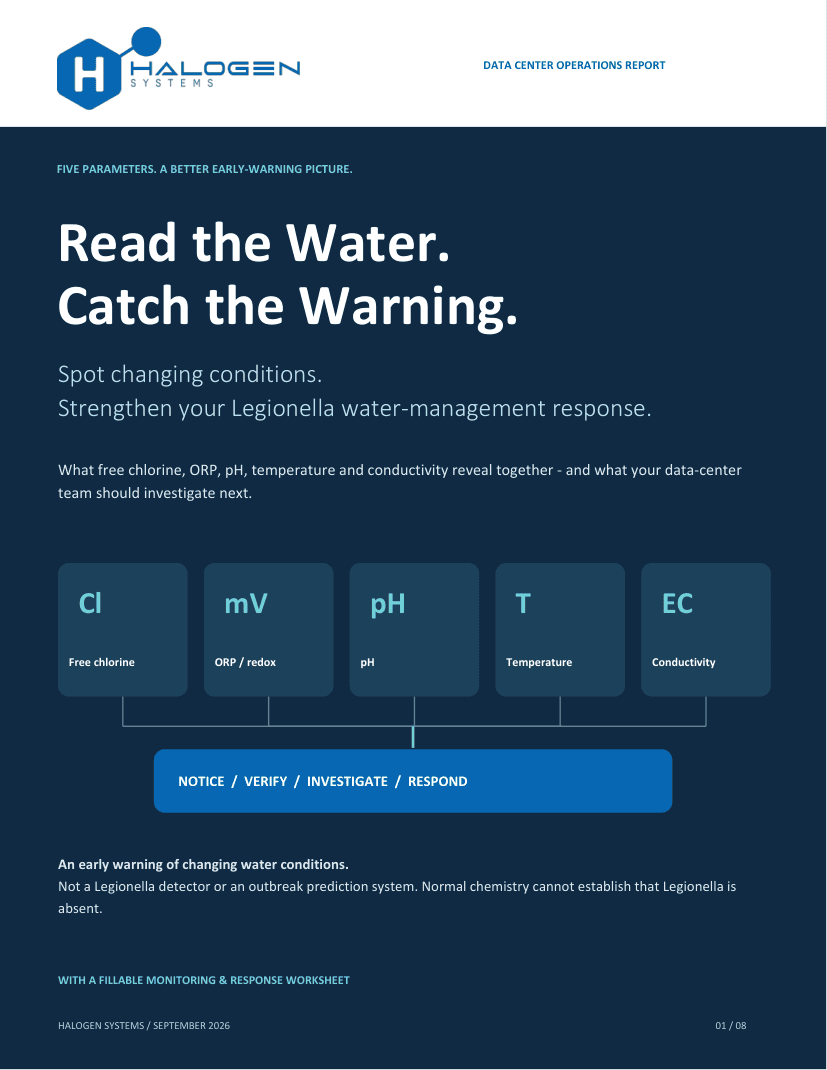
8 pages. Five signals. A practical response plan.
Chemistry trends can flag conditions for investigation. They do not detect Legionella or predict an outbreak.
Get your free report
Complete the form to access the PDF immediately.
We use your details to process your download request. This form does not subscribe you to marketing emails. Privacy policy.
Connect water measurements to the systems your team uses.
Give each incoming-water, storage and cooling-loop point a clear identity. Trend free chlorine, pH, temperature, conductivity and ORP alongside dosing and equipment events so operators can compare locations and identify what changed. Include data freshness and available sensor status in the view.
Use the BMS/DCIM communications guide to compare the three layers, review D20 interface options and plan point mapping, alarms and communications-loss behavior.
The operating problem: different building areas, different conditions
Water entering a facility and water at a remote outlet can have different histories. Storage, circulation, temperature and patterns of use affect where a facility should evaluate conditions. A single entry-point reading cannot describe every branch or identify every potential risk.
Begin with the building-water system description and the responsible program team. Identify the control points and the actions a measurement is intended to support. Instrumentation should strengthen an existing management process rather than substitute for defining responsibilities and procedures.
Turn changing chemistry into an investigation
Track residual and temperature at program-selected locations. Use pH to interpret chlorine chemistry and conductivity and ORP to provide context for source or treatment changes. Compare active and standby periods and investigate departures against site-defined limits.
For example, a warmer storage outlet with declining free chlorine calls for a different review from a conductivity shift appearing first at the inlet. The trends help focus the investigation; they do not establish the cause or measure bacteria.
Follow the site program for corrective action, inspections, cleaning and microbial testing. CDC cooling-tower guidance describes the broader operating controls.
Choose control points through the site program
| Candidate point | Measurement purpose | Issue to investigate | Product and specification considerations |
|---|---|---|---|
| Potable-water entry | Utility residual and temperature baseline | A change arriving with the supply | MP5 for free chlorine or MP-TOTAL for appropriate chloramine/total measurement; contact certification and matrix review |
| Storage outlet | Residual/temperature after storage | Conditions associated with residence and turnover | Representative placement, tank level and approved mounting; spatial checks may still be needed |
| Selected cold-water distribution point | Conditions at a designated program location | Difference from the incoming baseline | Approved chemistry/ranges, access, representative sample and complete assembly |
| Selected hot-water supply/return | Program-relevant temperature and residual | A change at the defined hot-water control point | MP-HOT only after verified analyte, temperature and certification scope; no assumed thermal-disinfection compatibility |
| Remote building or low-use area | Conditions at the selected point | Changes during a defined use pattern | Representative water, no-flow interpretation, power, communication and response responsibility |
The monitoring plan must explain why each location was selected and which unmonitored areas remain outside its representation. Do not imply a sensor flushes stagnant plumbing or corrects a hydraulic problem.
Select chemistry, temperature and contact materials together
Use the utility's disinfectant information to choose the analyte. Free chlorine and monochloramine should not be used interchangeably in specifications. MP5, MP-TOTAL and MP-HOT are candidate routes, not approvals for every potable-water condition. Request the engineering-approved configuration and operating specification before procurement.
For drinking-water contact, obtain certification documentation for the exact wetted components and conditions. NSF/ANSI/CAN 61 concerns health effects from contact materials; it is not evidence that the instrument detects pathogens or assures disinfection performance.
Installation and service access
Halogen's membrane-free, reagentless bare-electrode design uses mechanical self-cleaning. Its installation still needs appropriate wetted materials, isolation and a representative reference-sampling point. Direct in-pipe, approved wet-tap, PVC-tee, immersion or sampling arrangements must be selected for the particular water system. See the manufacturer product catalog.
Include exceptional operating conditions
Ask whether cleaning, disinfection or temperature excursions exceed normal conditions and what the approved instrument procedure should be. Do not infer tolerance from the product name. Confirm that maintenance access and removal procedures protect personnel and the potable-water system.
Records, controls and corrective actions
Map the approved controller outputs to the building system and distinguish an out-of-limit reading from loss of valid data. If remote trends and alerts are used, confirm the selected service supports the required record retention and escalation process.
A suggested record includes the control point, measurement, applicable limit, alarm, verification result, responsible person, action and follow-up. This is an engineering workflow recommendation, not a claim that every software platform supplies that record automatically. Any treatment adjustment requires the site's authorized procedure.
Maintenance and water use
Independent checks and manufacturer-prescribed service remain part of the plan. Changing measurement technology may remove some reagent or membrane tasks, but it does not remove inspections or program verification. Compare the actual service requirements rather than selecting an instrument from a generic maintenance interval.
A suitable direct installation can avoid continuous analyzer sample discharge. Keep required flushing, independent sampling and other water-management actions separate from that calculation. Water-efficiency messaging must not encourage the team to abandon necessary program activities.
ASHRAE 188 and regulatory context
For systems within its scope, ASHRAE Standard 188 establishes water-management program requirements; it does not specify a named chlorine analyzer. Determine the applicable edition and any jurisdictional adoption with the responsible reviewer. CDC material is guidance, not a universal legal mandate. Continuous readings may support program documentation but do not create automatic compliance. See ASHRAE's official information.
Engineering specification
Provide the building-system description, program control points, utility disinfectant, desired analytes, normal and excursion conditions, hydraulic/mounting details, applicable contact certification, reference procedure, record requirements and alarm responsibilities. Obtain water-management team approval and an engineering-approved model/assembly schedule. Include only approved operating specifications in a tender.
Preserve water-management controls during conservation changes
A change in source, storage, turnover or operating strategy can also change water-management conditions. Coordinate conservation work with the responsible water-management team and retain required testing and response procedures. Lower water use is not evidence that microbial risk has been controlled.
Keep the evidence connected
Combine timestamped residual trends with reference checks, maintenance records, source changes and the site’s required testing. Use the troubleshooting guide for measurement discrepancies and the BMS point-list template to document data and alarm ownership.
Questions & answers
Can continuous chlorine monitoring support an ASHRAE 188 program?
Yes, suitable measurements can contribute operating records at control points selected by the water-management team. The program must still define limits, verification and corrective actions and address other applicable requirements. ASHRAE 188 does not mandate a particular Halogen analyzer, and installing instrumentation alone does not establish compliance with the standard or local rules.
Does this instrument monitor Legionella directly?
No. A chlorine sensor measures a disinfectant residual, not the organism. Residual and temperature records can inform the facility's water-management activities, but they cannot demonstrate that Legionella is absent. Microbial testing, where required or specified by the program, uses separate methods and must be interpreted by the responsible team.
Is MP-HOT suitable for every hot-water system?
No. The selected assembly needs approval for the actual disinfectant, normal temperature, excursions and drinking-water contact conditions. Product naming is not an operating specification. Confirm the controlling datasheet with Halogen engineering, including what to do during any thermal or chemical disinfection procedure that falls outside approved operating limits.
Does NSF/ANSI 61 certification prove measurement accuracy?
No. The standard addresses health effects associated with materials in drinking-water contact; it is not a chlorine-accuracy or pathogen-removal certification. Request the listing for the exact model, wetted components and conditions. Evaluate measurement performance and the reference-check procedure separately as part of the site's instrument selection and commissioning.
Can continuous monitoring replace microbial testing and inspections?
No. Online residual records answer a different question from microbial tests and physical inspections. Keep all activities required by the applicable program and responsible authorities. Use the readings alongside independent verification and other evidence, and document how unexpected results are investigated rather than treating a normal trend as proof of safety.
Should potable water and tower water share control limits?
Do not assume they should. These systems have different uses, treatment conditions and management requirements, even if they share an incoming supply. The responsible teams should define suitable measurements and limits for each system. Keep their point names, records and response procedures distinct so a reading is interpreted in the correct context.
Plan your water-quality monitoring points.
Bring your water sources, cooling-loop layout and treatment program. We can help review five-parameter MP5F monitoring, low-maintenance installation options, sample-water savings and the data your operations team needs.
Follow the water through your facility.
Know your water. From incoming supply to every cooling loop.
Monitor free chlorine, pH, temperature, conductivity and ORP across data-center facility water. Explore low-maintenance sensing and analyzer water savings.
Understand the water in every cooling tower.
Use free chlorine, pH, temperature, conductivity and ORP trends to understand cooling-tower treatment, concentration and changing operating conditions.
Know the water entering your cooling system.
Establish incoming and tower-makeup baselines for free chlorine, pH, temperature, conductivity and ORP. Follow source, storage and blending changes.
Keep the measurements. Reduce the water sent to drain.
Compare low-maintenance MP5F water-quality monitoring with existing sample drains. Quantify analyzer water savings across your data-center campus.
How much water could your monitoring points save?
Calculate annual sample-water savings from direct MP5F installation. Compare drain flow, operating hours and monitoring points, then download your estimate.
See what changes when your water source changes.
Monitor free chlorine, pH, temperature, conductivity and ORP when data-center water sources or blends change. Compare incoming and cooling-loop conditions.
Manage concentration with a clearer view of tower water.
Use MP5F conductivity, pH, temperature, free chlorine and ORP trends to support treatment-approved cooling-tower concentration and blowdown decisions.
Use five water-quality trends to find the next check.
Investigate changing residual with pH, temperature, conductivity and ORP. Compare supply and loop trends, verify samples and check BMS data.