A building’s water conditions can change between visits. Continuous disinfectant-residual and temperature measurements help your team recognize excursions, investigate the affected loop and document its response.
Legionella risk monitoring tracks water conditions that influence bacterial growth. Chlorine and temperature sensors support that work; they do not test for Legionella. Use continuous measurements alongside a water management program, reference checks and appropriate microbiological testing.
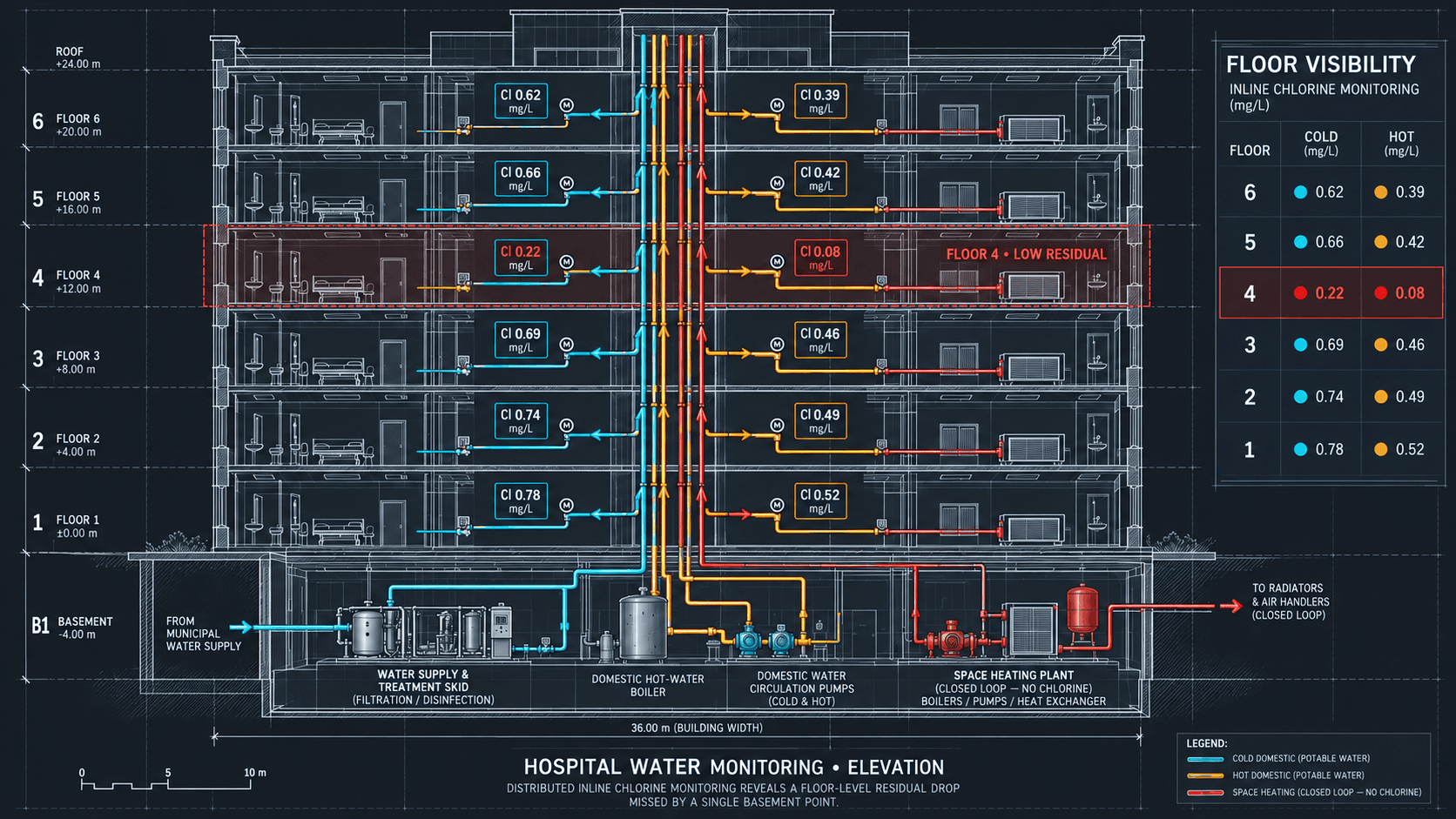
A distributed network—or “swarm”—of sensors helps your team see local changes that a single plant-room reading can miss. Compare hot-water returns and cold-water branches to narrow the investigation to a floor or monitored zone.
View the architectural reference diagramCold potable waterDomestic hot waterSeparate space-heating circuitConceptual section; simplified routing and sensor symbols. Not an installation drawing. HVAC heating and chilled-water circuits are separate systems.
01 · LOCATE
Smaller problems become visible
A loss of residual on one return can point to a local condition. Similar changes across several floors can suggest a shared upstream issue. Sensor placement and the actual pipe network determine how closely you can locate it.
02 · INVESTIGATE
Five measurements add context
Measure chlorine directly, with pH, temperature, conductivity and ORP as complementary signals. Check sensor status and reference measurements, then investigate circulation, water age or changed water chemistry. Readings alone do not establish the cause.
03 · RESPOND
Support the patient-protection plan
Route excursions to the facility’s water management team, follow the agreed response and document recovery. These sensors identify water-quality changes; they do not detect Legionella, confirm biofilm or establish that every outlet is safe.
FROM MEASUREMENT POINT TO CUSTOMER REPORT
Plan the mounting. Connect the network.
A PVC tee (PVCT) provides direct inline mounting where the complete assembly is compatible and the pipe can be isolated for service. Select a temperature- and pressure-rated assembly for each location; do not assume a PVC tee is suitable for hot water.
For compatible hot-water points, review MP-HOT’s 1–60°C operating range against normal operation and disinfection cycles. Connect sensors through Smart Boxes via Modbus RTU to a compatible controller, then configure location names, trends and alarm routing in the receiving system.
More points. Fewer blind spots.
Add representative floor returns, remote branches and building-entry measurements according to the water management plan. More sensors improve spatial coverage; they do not automatically monitor every fixture.
On the cold-water side, compare the incoming disinfectant residual with representative remote points. Low use, long residence time and warming can change conditions after water enters the building. Match the instrument to the disinfectant actually supplied: free chlorine, total chlorine and monochloramine are different measurement objectives.
On the hot-water side, review circulation, local returns and mixing arrangements. A central return combines water from multiple branches; a satisfactory central reading does not establish conditions in every branch. Select a sensor that tolerates the complete operating temperature range at its installation point.
What happens between visits?Illustrative coverage comparison — not measured data.
Scheduled checks● Time between checks ●
Continuous measurementTrend → excursion → investigation → response record
Continuous readings add time-series information at the installed points. Reference samples still help verify measurement performance.
Measure at points that answer an operating question.
Agree the monitoring locations with the building’s water management team before specifying equipment. Map the water path, identify service access and pair each location with a practical verification point.
Building entry: establish the incoming residual and temperature baseline.
After on-site treatment: observe the measured residual downstream of the treatment process.
Representative remote cold-water branches: compare local conditions with the entry baseline.
Hot-water main return and selected floor returns: investigate differences between loops.
Low-use areas: combine representative monitoring with inspections and the site’s flushing and sampling procedures.
Use direct chlorine measurement with supporting signals.
A chlorine result reports residual concentration. ORP reports oxidation-reduction potential, which also responds to pH and other water chemistry. Halogen measures chlorine directly by amperometry; it does not convert ORP into a chlorine concentration.
Temperature and pH help interpret treatment conditions. Conductivity and ORP add context when water chemistry changes. Confirm the configured channels and record sensor faults as well as measurements. None of these signals identifies a pathogen or proves that water is safe.
Monitoring is one part of the water management program.
ASHRAE Standard 188 provides a risk-management framework; Guideline 12 provides supporting guidance. Applicability depends on the building and the requirements adopted for it. A sensor installation does not itself establish compliance.
Build a reviewable record: location, time, measured value, control limit, sensor status, verification result, corrective action and the person responsible. Verification asks whether the program is being carried out as intended. Validation asks whether it is effective. A trend log contributes evidence but does not complete either task on its own.
Evaluate MP5 for free-chlorine measurement in compatible cold-water applications, MP-Total for the selected total-chlorine or monochloramine measurement, and MP-HOT for compatible hot-water returns. Confirm chemistry, pressure, temperature, installation and outputs against the current specifications.
D20 provides a local control and interface option. An OEM can integrate through a Smart Box to a compatible third-party controller using Modbus RTU. Remote access requires the appropriate communications hardware, software and network; Bluetooth access alone is not remote monitoring.
No. It measures disinfectant residual. Temperature and other chemistry measurements help identify changing water conditions; testing for Legionella is a separate activity.
Does continuous monitoring replace grab samples?
No. Keep reference checks, microbiological testing, inspections and required sampling in the water management program. Continuous measurements add visibility between those activities.
Is cold water part of Legionella risk management?
Yes. Assess incoming water, storage, warming, low-use branches and representative remote locations as well as the hot-water system.
Does installing a sensor satisfy ASHRAE 188?
No. Equipment can support a documented program; it does not establish compliance or replace the responsible team’s control measures.
Guidance and sources
Use these primary sources with the requirements applicable to your building. Product limits should be checked against the selected model’s current documentation.