
Manage concentration with a clearer view of tower water.
How concentrated is the tower water, and what else changes when the blowdown valve operates? MP5F conductivity helps track dissolved-ion concentration alongside pH, temperature, free chlorine and ORP. Bring those trends together with makeup and blowdown volumes to support the treatment team’s operating decisions.
Plan My Water-Quality Monitoring ↗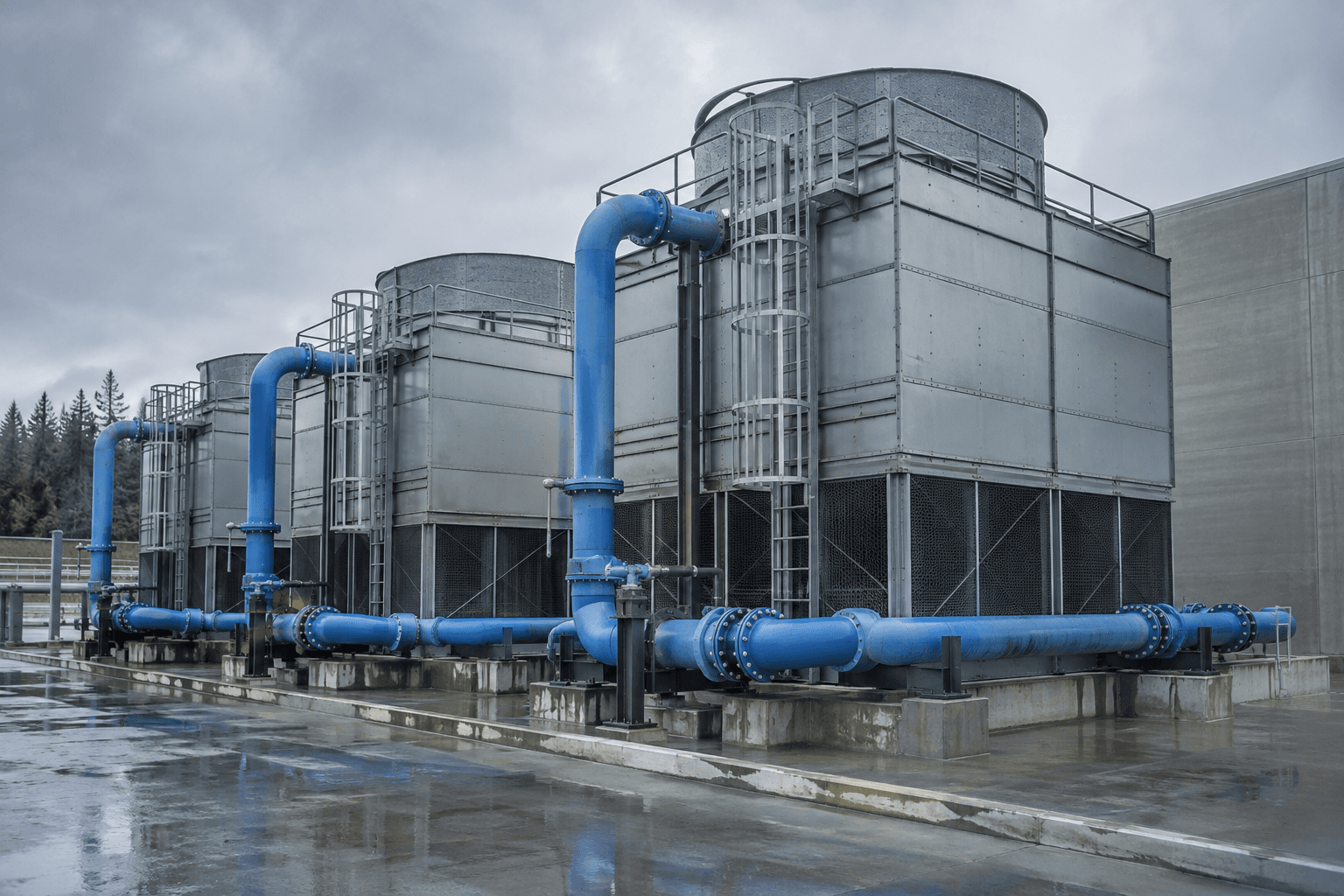
- Makeup waterEstablish incoming chemistry
- Storage / treatmentReview turnover and water quality
- Tower & recirculationSelect compatible monitoring points
- Controller & BMSSend measurements and status
Conceptual monitoring sequence. The controller receives data. Blowdown remains a separate process-water stream; potable water and server coolant require separate evaluation.
Connect water measurements to the systems your team uses.
Give each incoming-water, storage and cooling-loop point a clear identity. Trend free chlorine, pH, temperature, conductivity and ORP alongside dosing and equipment events so operators can compare locations and identify what changed. Include data freshness and available sensor status in the view.
Use the BMS/DCIM communications guide to compare the three layers, review D20 interface options and plan point mapping, alarms and communications-loss behavior.
Keep the water balance visible
For a defined tower boundary, makeup water replaces evaporation, blowdown, drift and other losses. Meter makeup and blowdown where practical, and investigate unexplained differences before attributing them to a sensor or control change. Record operating load and weather alongside water data.
Use conductivity in context
Cycles of concentration can be estimated from tower-water conductivity divided by makeup-water conductivity when conductivity is an appropriate concentration indicator. The treatment provider should evaluate the chemistry and permitted operating limits before selecting a setpoint. See EPA WaterSense cooling-tower guidance.
Chemical additions, varying source water and other effects can complicate interpretation. A higher conductivity number is not automatically a better operating target. Review scaling, corrosion and treatment constraints as well as water use.
Connect concentration, treatment and operating events
| Measurement | What it contributes |
|---|---|
| Conductivity | Track tower concentration relative to makeup where the ratio is valid for the chemistry. |
| pH | Follow treatment conditions relevant to scaling, corrosion and chlorine chemistry. |
| Free chlorine | Review residual through dilution, dosing and discharge events. |
| Temperature | Relate water-quality changes to operating and thermal conditions. |
| ORP / redox | Add oxidation/reduction context to treatment response. |
| Separate flow meters and equipment status | Confirm actual makeup/blowdown volumes and valve behavior. |
Specify the MP5F conductivity signal and controller interface as part of the complete control design. The treatment provider sets appropriate limits using source chemistry, additives and equipment requirements. The sensor does not directly measure scale, corrosion or water volume.
Investigate avoidable discharge
- Check for a blowdown valve that passes water when commanded closed.
- Compare controller readings with an appropriate reference and inspect the measurement point.
- Confirm makeup-water conductivity after a supply change.
- Check schedules, overrides, leakage and unrecorded bypass drains.
Have the treatment and controls teams review corrective actions. Do not reduce blowdown solely to improve a water-use metric.
Document the change
Create a baseline with paired water volumes, chemistry and operating data. After an approved change, compare equivalent conditions and retain alarm and service records. Describe results as site-specific measurements, not a universal saving from a chlorine sensor.
For the separate sample-drain opportunity, use the analyzer water-savings calculator.
Questions & answers
Can MP5F conductivity support cooling-tower blowdown control?
Yes, its conductivity measurement can be specified as an input to an approved control design, subject to range, installation and interface compatibility. The treatment provider sets the concentration limits. MP5F also measures free chlorine, pH, temperature and ORP; the sensor itself is not the blowdown valve, flow meter or complete control system.
What are cycles of concentration?
They describe how concentrated recirculating water is relative to makeup water. A conductivity ratio can be useful when appropriate for the chemistry; confirm the method and operating limit with the treatment provider.
Should we always increase cycles of concentration?
No. The allowable operating range depends on chemistry, treatment and equipment limits. Increasing concentration beyond those limits can create operational problems.
Why is the tower still losing water when blowdown is closed?
Possible causes include evaporation, drift, leakage, a passing valve or other discharge paths. Establish the water balance and inspect the installation instead of assuming a single cause.
Can blowdown savings be added to analyzer savings?
Only when the measured boundaries do not overlap. If an analyzer drain is already included in the discharge total, counting it again would overstate savings.
What water-quality data should we trend in the BMS?
Trend free chlorine, pH, temperature, conductivity and ORP by location. Add separately measured makeup and blowdown volumes, valve and equipment status, dose timing and available sensor diagnostics. Confirm mapping, timestamps and responsibility for alarm response.
Plan your water-quality monitoring points.
Bring your water sources, cooling-loop layout and treatment program. We can help review five-parameter MP5F monitoring, low-maintenance installation options, sample-water savings and the data your operations team needs.
Follow the water through your facility.
Know your water. From incoming supply to every cooling loop.
Monitor free chlorine, pH, temperature, conductivity and ORP across data-center facility water. Explore low-maintenance sensing and analyzer water savings.
Understand the water in every cooling tower.
Use free chlorine, pH, temperature, conductivity and ORP trends to understand cooling-tower treatment, concentration and changing operating conditions.
Know the water entering your cooling system.
Establish incoming and tower-makeup baselines for free chlorine, pH, temperature, conductivity and ORP. Follow source, storage and blending changes.
Make water-quality changes visible to your water-management team.
Track residual, temperature and water-quality changes at data-center control points. Support a documented Legionella water-management response.
Keep the measurements. Reduce the water sent to drain.
Compare low-maintenance MP5F water-quality monitoring with existing sample drains. Quantify analyzer water savings across your data-center campus.
How much water could your monitoring points save?
Calculate annual sample-water savings from direct MP5F installation. Compare drain flow, operating hours and monitoring points, then download your estimate.
See what changes when your water source changes.
Monitor free chlorine, pH, temperature, conductivity and ORP when data-center water sources or blends change. Compare incoming and cooling-loop conditions.
Use five water-quality trends to find the next check.
Investigate changing residual with pH, temperature, conductivity and ORP. Compare supply and loop trends, verify samples and check BMS data.