Less routine sensor work
Reagent-free measurement and SensiCLENE automatic cleaning reduce reagent handling and routine electrode cleaning. Plan verification and wear-part service for the actual water conditions.

Better treatment insight. Less water and heat down the drain.
Direct chlorine measurement for the people treating building water and the people paying to operate it. Monitor hot-water loops in the pipe, bring measurements into your controller, and see what is happening across the building.
Download sensor datasheets ↓
Give customers a clearer record of treatment performance between service visits. Build a monitoring offer around dependable measurements, less routine upkeep and useful reporting.
Reagent-free measurement and SensiCLENE automatic cleaning reduce reagent handling and routine electrode cleaning. Plan verification and wear-part service for the actual water conditions.
MP-HOT’s published chlorine accuracy is ±5% of reading or 0.04 mg/L, whichever is greater. Direct residual measurements give your team a quantitative basis for reviewing treatment and investigating changes.
Bring trends, excursions and before-and-after service records into your reporting system. Show where residual is being lost, document the response, and make the value of your service visible.
Combine equipment, commissioning, remote trend review and scheduled maintenance into an ongoing monitoring service. Floor-by-floor visibility and measured operating-cost reductions give you more to discuss than the last grab sample.
Discuss a treatment or OEM projectA once-through sample-cooler installation can send two water streams to drain: the hot sample and the cold water used to cool it. Direct in-pipe MP-HOT monitoring removes both measurement-related waste streams.
Costs depend on sample flow, cooler design, operating hours and local utility rates.
The sensor still uses electrical power and needs planned service. Normal building heating and circulation costs remain.
Illustrative inputs, not measured site data. Adjust the values to estimate annual water and replacement-heating costs avoided by removing a once-through hot sample and its cooling-water stream.
Halogen uses amperometric chlorine measurement. ORP is a separate measurement that adds context; it is not the source of the chlorine reading.
A chlorine reading reports residual concentration in mg/L (ppm). It lets a water treater compare the residual against the site’s treatment targets, track losses through the building and verify the effect of an adjustment.
ORP reports an electrochemical potential in millivolts. It responds to the combined oxidizing and reducing conditions, including pH, temperature and other species. There is no universal conversion from an ORP value to chlorine concentration.
Changes in water chemistry can alter ORP without a matching change in chlorine concentration. Direct chlorine measurement separates the residual question from that broader signal, helping teams investigate low residual and make informed dosing decisions. Use pH, temperature and ORP alongside chlorine to understand the conditions.
Measure directly in compatible hot-water circulation and return piping, without cooling the sample first. Published operating temperature: 1–60°C (up to 140°F). Check the complete temperature profile, including thermal disinfection cycles, when selecting the installation.
MP-HOT datasheet (PDF)Track free chlorine alongside the other water-quality signals to support treatment review. Confirm oxidant chemistry, temperature, fouling conditions and mounting with your water treater. Monitoring-related water savings do not eliminate required cooling-tower blowdown.
MP5 datasheet (PDF)
Plan sensors at building entry, the main return and appropriate floor or end-of-line return points. Compare local trends to see where residual or temperature is changing, then route that information to the people responsible for the response.
Chlorine, pH, temperature, conductivity and ORP help the team recognize changing water conditions. Configure site-specific alarms in the receiving system, assign a response owner and retain trends for customer reports.
Falling residual or temperatures outside the water management program’s limits can prompt investigation of conditions associated with Legionella growth. These measurements do not detect Legionella or predict an outbreak; microbiological testing and the building’s water management program remain essential.
Confirm the five-channel configuration for the selected sensor. Place each probe in representative water with suitable access for service and verification.
CDC guidance on monitoring building water ↗Track the measured disinfectant residual and identify loss between building entry and remote returns.
Understand changes that affect chlorine chemistry and treatment performance.
See whether monitored hot-water locations remain within your water management program’s limits.
Identify changes in dissolved-ion content that may warrant investigation.
Add oxidation-reduction context alongside the independently measured chlorine residual.
A distributed network—or “swarm”—of sensors helps your team see local changes that a single plant-room reading can miss. Compare hot-water returns and cold-water branches to narrow the investigation to a floor or monitored zone.
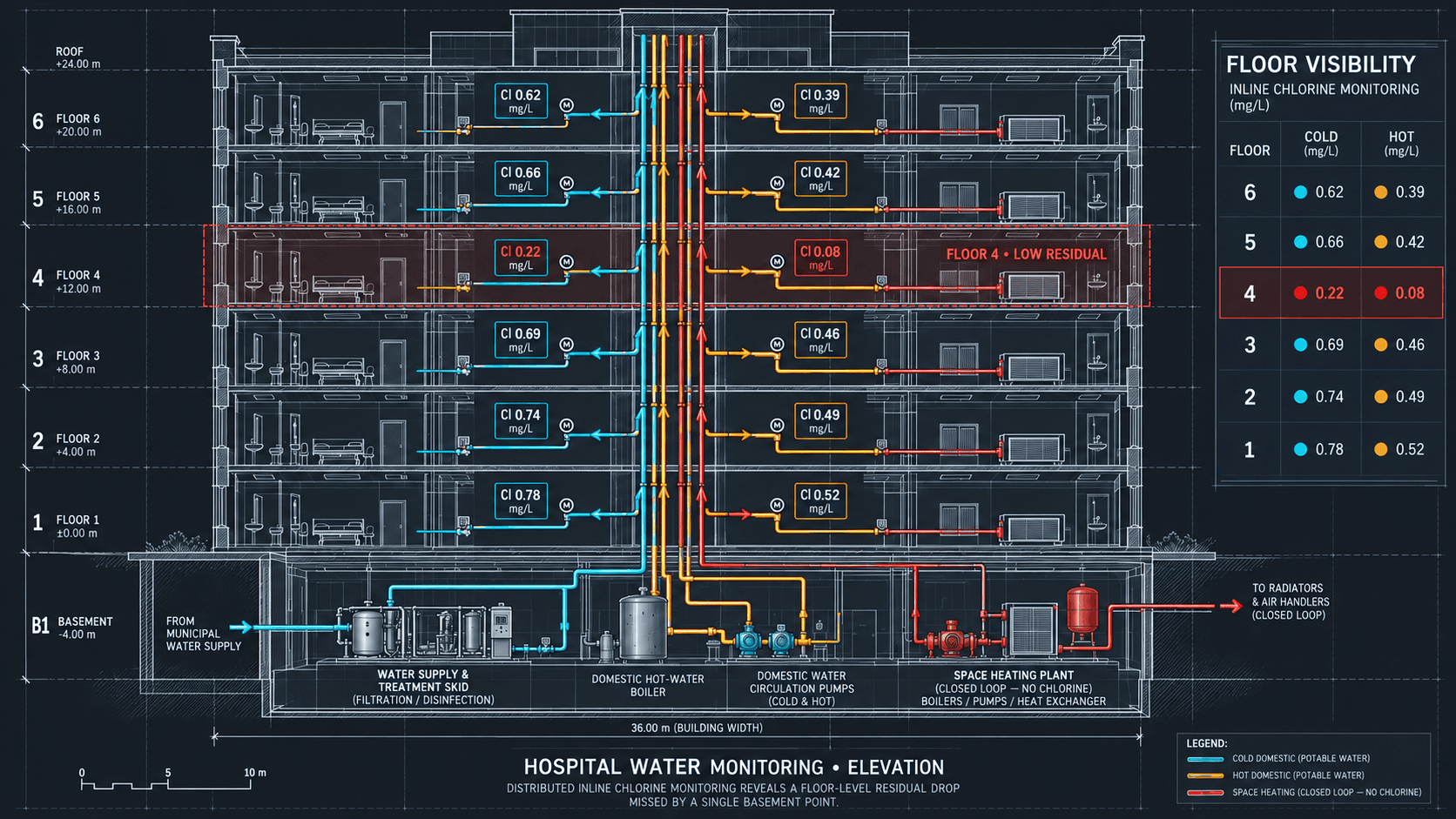
A loss of residual on one return can point to a local condition. Similar changes across several floors can suggest a shared upstream issue. Sensor placement and the actual pipe network determine how closely you can locate it.
Measure chlorine directly, with pH, temperature, conductivity and ORP as complementary signals. Check sensor status and reference measurements, then investigate circulation, water age or changed water chemistry. Readings alone do not establish the cause.
Route excursions to the facility’s water management team, follow the agreed response and document recovery. These sensors identify water-quality changes; they do not detect Legionella, confirm biofilm or establish that every outlet is safe.
A PVC tee (PVCT) provides direct inline mounting where the complete assembly is compatible and the pipe can be isolated for service. Select a temperature- and pressure-rated assembly for each location; do not assume a PVC tee is suitable for hot water.
For compatible hot-water points, review MP-HOT’s 1–60°C operating range against normal operation and disinfection cycles. Connect sensors through Smart Boxes via Modbus RTU to a compatible controller, then configure location names, trends and alarm routing in the receiving system.
Add representative floor returns, remote branches and building-entry measurements according to the water management plan. More sensors improve spatial coverage; they do not automatically monitor every fixture.
Request sensor specifications ↗CDC: monitoring building water ↗For OEM applications, connect the sensor through a Smart Box to a compatible third-party controller using Modbus RTU. Build Halogen measurement into your own treatment skid, operator interface and customer reporting workflow.
Use the compatible OEM or third-party controller to display measurements and implement your own treatment logic.
Confirm Smart Box configuration, power, wiring, register mapping, units and communication settings with Halogen.
Configure polling, sensor status, communication-loss handling and alarm routing. Connect the controller to your customer reporting system.
Complete one form for instant access to both sensor datasheets.
Plan hot- and cold-water residual monitoring to support your Legionella water management program. Guidance for building owners and water treatment providers.
BUILDING OWNERSSee how continuous water-quality monitoring supports building water management, operating-cost decisions and coordination with your water treater.
WATER TREATERSPlan residual monitoring, OEM integration and service reporting for building water management. Explore sensor selection and a practical customer pilot.
Share your water chemistry, operating temperatures, controller model and proposed monitoring points. For a cost review, include sample and cooling-water flows and utility rates.