Multiple buildings
Identify representative monitoring points across a campus.

Make water-system trends easier to follow.
Help facility teams observe incoming and recirculating water conditions across complex buildings. Pair continuous measurement with a documented water management program.
Discuss your application
Identify representative monitoring points across a campus.
Review separate configurations for each operating environment.
Use monitoring data alongside inspections, testing, and corrective-action records.
A basement return sensor sees the blend. A sensor swarm sees each floor. When Floor 3 loses its hot-water chlorine residual, water from the other floors raises the mixed reading — hiding where the loss occurred. Monitor before the returns mix to locate the affected floor.
A loss of residual on one return can point to a local condition. Similar changes across several floors can suggest a shared upstream issue. Sensor placement and the actual pipe network determine how closely you can locate it.
Measure chlorine directly, with pH, temperature, conductivity and ORP as complementary signals. Check sensor status and reference measurements, then investigate circulation, water age or changed water chemistry. Readings alone do not establish the cause.
Route excursions to the facility’s water management team, follow the agreed response and document recovery. These sensors identify water-quality changes; they do not detect Legionella, confirm biofilm or establish that every outlet is safe.
A PVC tee (PVCT) provides direct inline mounting where the complete assembly is compatible and the pipe can be isolated for service. Select a temperature- and pressure-rated assembly for each location; do not assume a PVC tee is suitable for hot water.
For compatible hot-water points, review MP-HOT’s 1–60°C operating range against normal operation and disinfection cycles. Connect sensors through Smart Boxes via Modbus RTU to a compatible controller, then configure location names, trends and alarm routing in the receiving system.
Add representative floor returns, remote branches and building-entry measurements according to the water management plan. More sensors improve spatial coverage; they do not automatically monitor every fixture.
Request sensor specifications ↗CDC: monitoring building water ↗A cooled, once-through sample can cost more than the measurement alone: purchased water, replacement heating, cooling water and drainage. MP-HOT measures directly in compatible hot-water piping, without those continuous sampling waste streams.
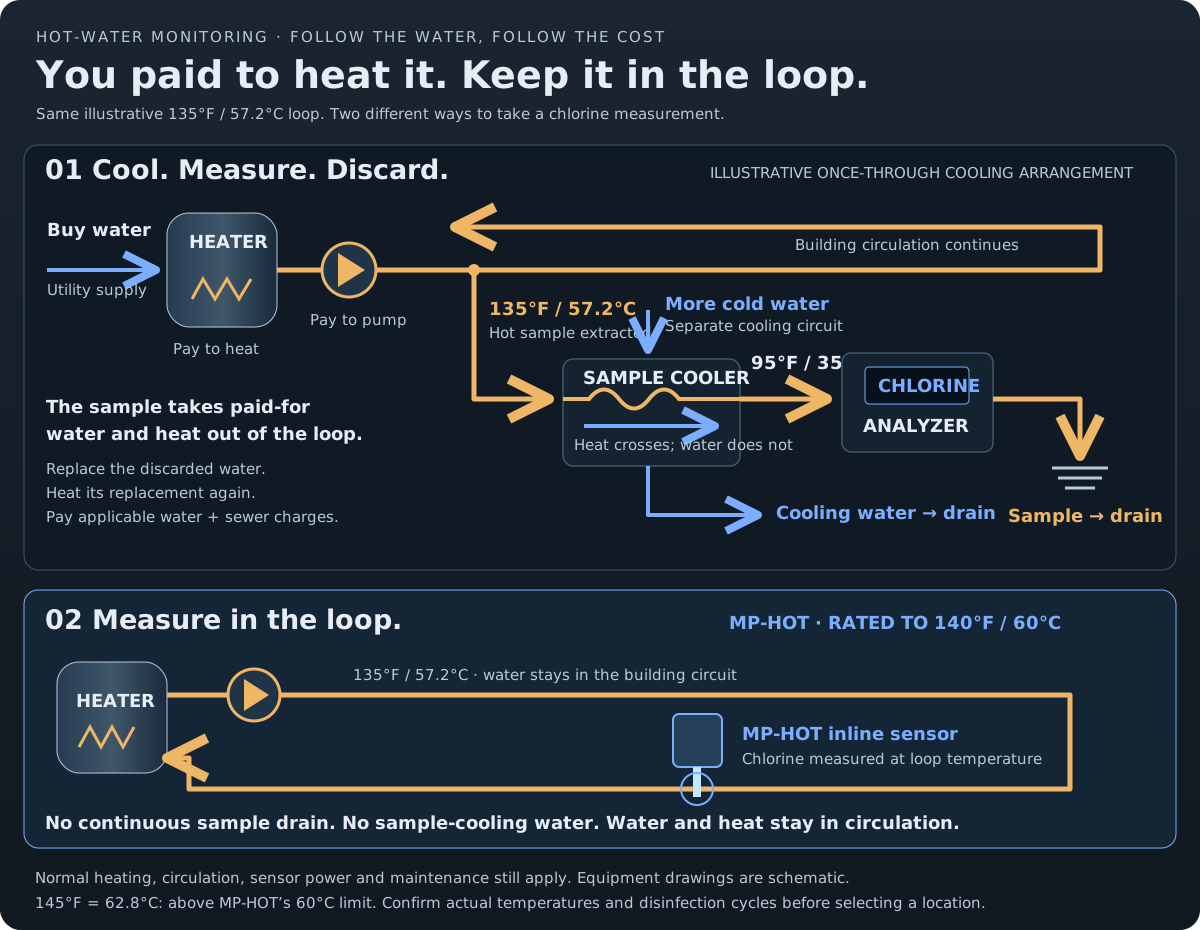
Account for the extracted sample and, where used, once-through cooling water. Apply your water and sewer tariff to the volumes actually billed.
The hot sample has already been heated. Replacing discarded water adds heating demand. Heat rejected in the cooler is part of that same energy loss, not a second heating charge.
Include cooler installation, piping, drains, fouling service and any additional sample or cooling pumps. Normal building-loop pumping remains with either approach; a separate sample pump is not always needed.
Estimate annual sampling costs across your sensors. Start with regional energy benchmarks, then use your bills and measured flows to refine the result.
Flows and pump power are per sensor. Only enter pump power that stops when sample cooling is removed, excluding building circulation. Closed-loop mode excludes cooling-water discharge; hot sample discharge remains. Region changes reset energy rates. Water/sewer starts at an illustrative $10/1,000 gallons, not a regional tariff.
Across 5 monitoring points · $519 per point/year
Assumes the entered drain streams are eliminated by compatible inline monitoring. This is a gross utility estimate, not net savings, payback or a quotation. Purchase, installation, sensor power and service, fixed utility charges, demand charges and heat recovery are excluded. Normal building heating and circulation remain.
EIA commercial electricity, July 2026; EIA commercial gas, 2025. Gas presets average available state prices in each region, excluding unavailable states, converted using an assumed 10.37 therms/Mcf. They are not official EIA regional averages. U.S. preset uses national data. Checked October 6, 2026; static benchmarks, not live tariff quotes.
Liters/year = mL/min ÷ 1,000 × 60 × hours × sensors. US gallons = liters ÷ 3.785411784. Heat (kWh thermal) = sample liters × 4.186 × (hot °F − incoming °F) × 5/9 ÷ 3,600. Gas therms = thermal kWh ÷ 29.307107 ÷ efficiency. Heat-pump kWh = thermal kWh ÷ COP; electric resistance assumes 100% point-of-use efficiency. Both discarded streams incur water cost; only the hot sample incurs replacement heating. Cooler heat rejection is not charged twice.
Send your assumptions and results to Halogen for a temperature, installation and savings review.
| Instrument | Upper limit | At the illustrated 135°F / 57.2°C point |
|---|---|---|
| Hach CL17sc ↗ | 40°C / 104°F | Sample must be cooled into the specified range. |
| Hach CLF10sc ↗ | 45°C / 113°F | Sample must be cooled into the specified range. |
| Halogen MP-HOT ↗ | 60°C / 140°F | Within its published temperature range for compatible direct installation. |
What about 145°F? That is 62.8°C, above MP-HOT’s 60°C rating too. Choose a monitoring point within the rating and verify pressure, mounting materials and the full temperature profile, including thermal disinfection. The illustration is not a recommendation to lower a building’s hot-water setpoint.
Selected products, not every competing sensor. Cooler requirements and drain arrangements depend on the installation. How a sample cooler separates the sample and cooling fluid ↗
Plan hot- and cold-water residual monitoring to support your Legionella water management program. Guidance for building owners and water treatment providers.
BUILDING OWNERSSee how continuous water-quality monitoring supports building water management, operating-cost decisions and coordination with your water treater.
WATER TREATERSPlan residual monitoring, OEM integration and service reporting for building water management. Explore sensor selection and a practical customer pilot.
Bring these questions to your application review.
This is water-chemistry monitoring, not pathogen detection or a guarantee of patient safety. Final placement and control limits belong to the facility’s qualified team.
The facility team can evaluate trends at selected incoming and recirculating points alongside inspections, sampling and maintenance records. Each alarm needs an assigned response owner.
No single sensor establishes compliance or patient safety. Confirm how the measurement fits the facility's documented program and retain the required testing and response procedures.
Tell us what you need to measure. We’ll help you find the right starting point.