Measure at the source.
Install MP5 Free or MP-Total with the sealed immersion assembly and a suitable pole or suspension mount. The impeller supplies local flow, including in still water.
No external sample circuit.
Simplify water-quality monitoring at every building. Halogen measures directly in the tank, using its own impeller to create sample flow. No external sample pump. No drain or return loop. MP5 Free delivers five water-quality measurements from one probe.
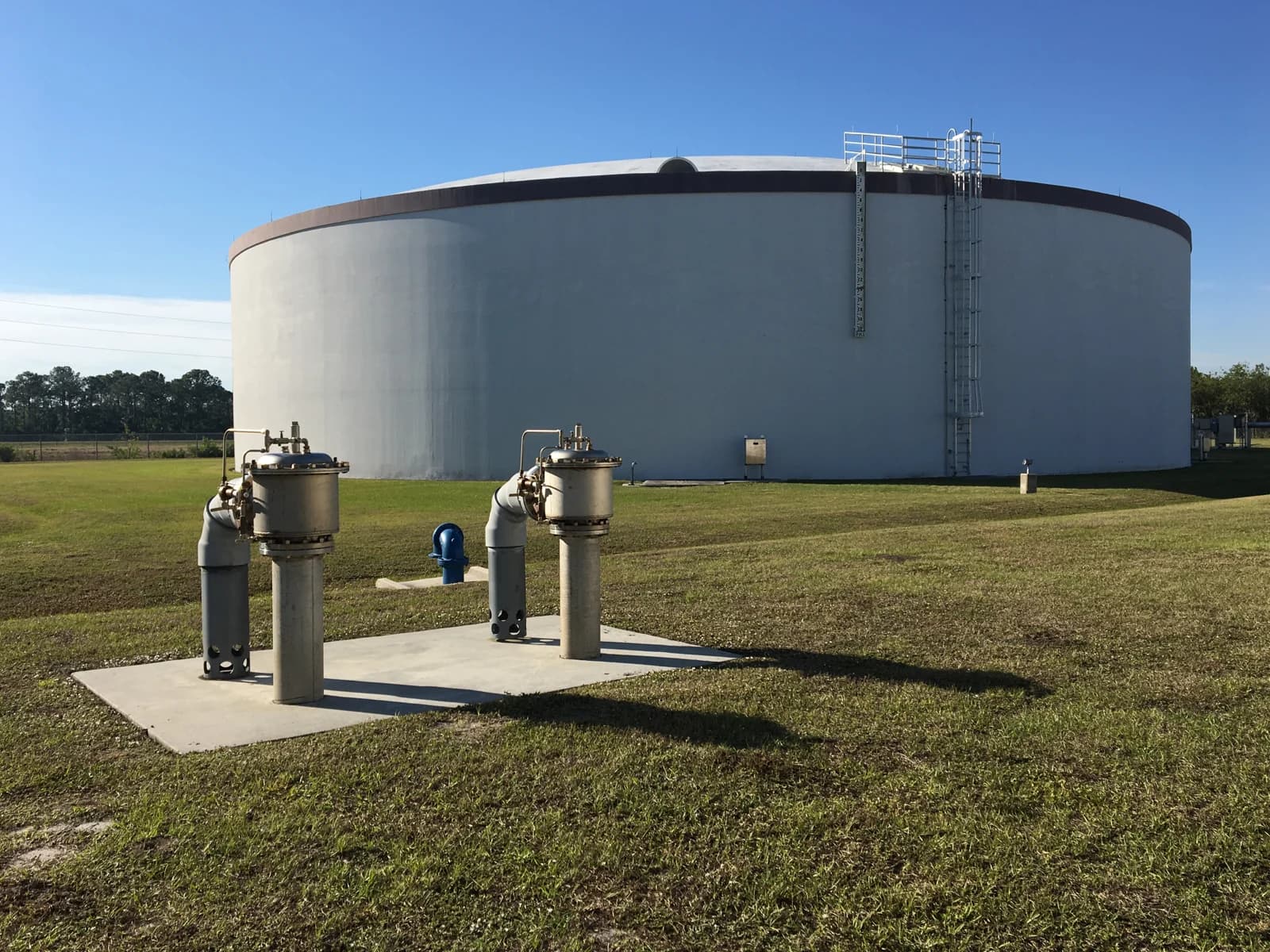
No external sample pump is needed with Halogen’s immersion configuration. Install the sealed MP5 Free or MP-Total sensor directly in the tank. Its integrated impeller creates the flow needed at the sensing surface—even when the surrounding water is still. Connect power and signal wiring to your selected controller or compatible telemetry unit. The water stays in the tank: no sample tubing to an analyzer, no drain and no return loop.
A supported immersion sensor puts the measurement directly inside the reservoir. Connect power and signal to your controller or telemetry system. There is no external sample pump, drain or return loop to install.
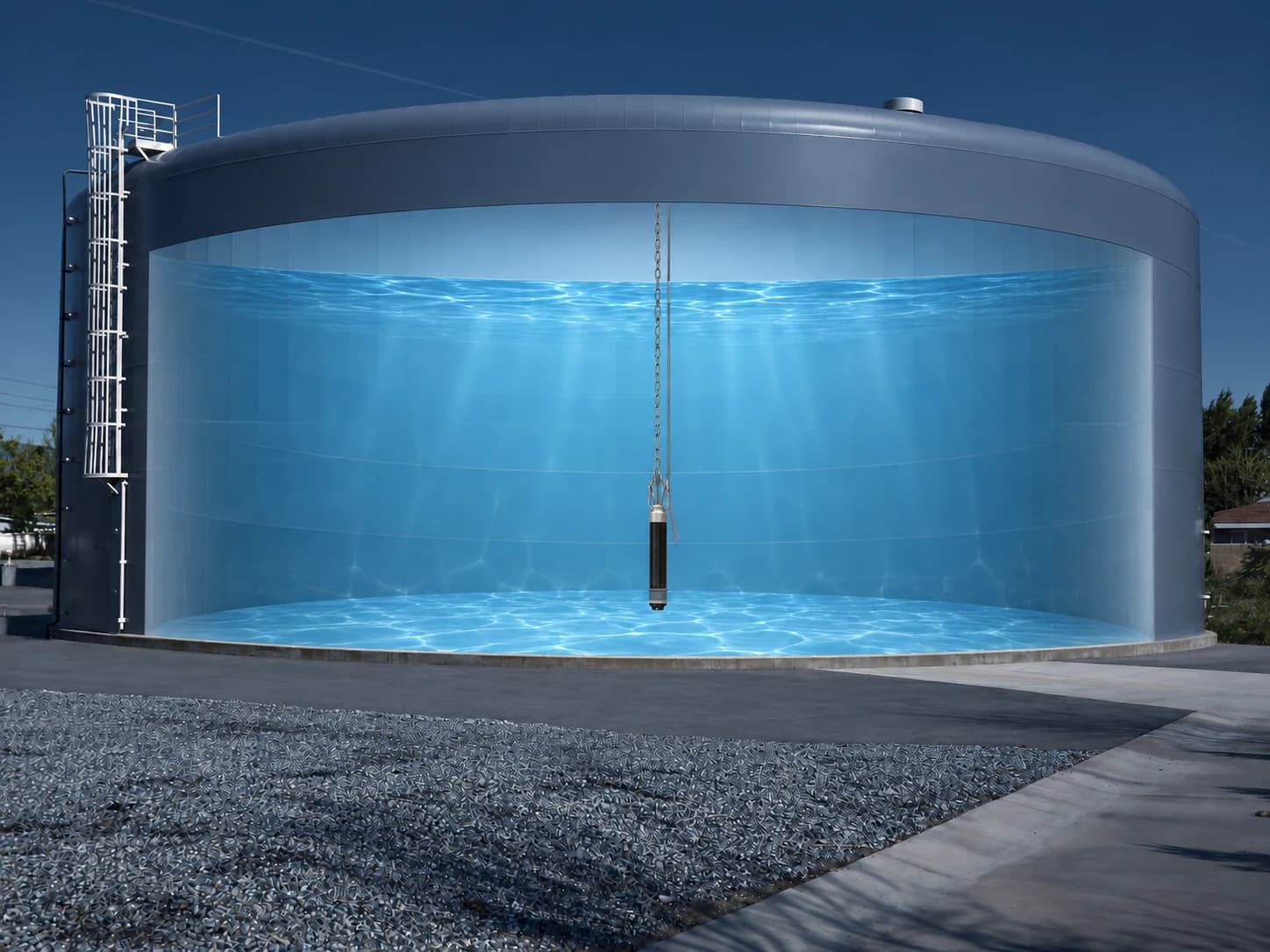
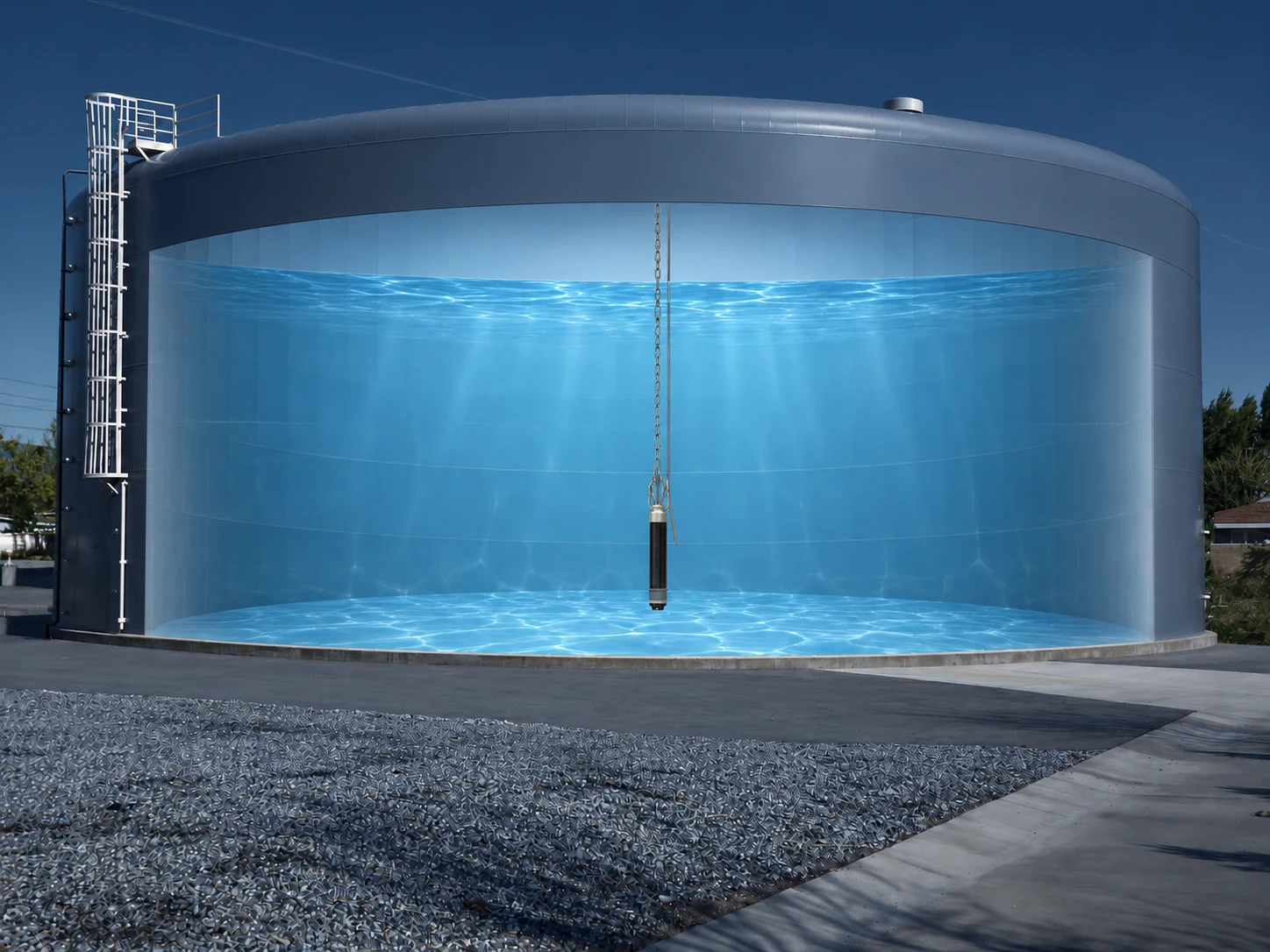
The suspension supports the sensor below the water surface and clear of the tank floor. The integrated impeller moves the surrounding water across the sensing surface.
No external sample pump. No sample line to an analyzer. No water sent to a drain.
See the actual mounting hardwareMeasure directly in your tank or reservoir—with no external sample pump, drain, or return line.
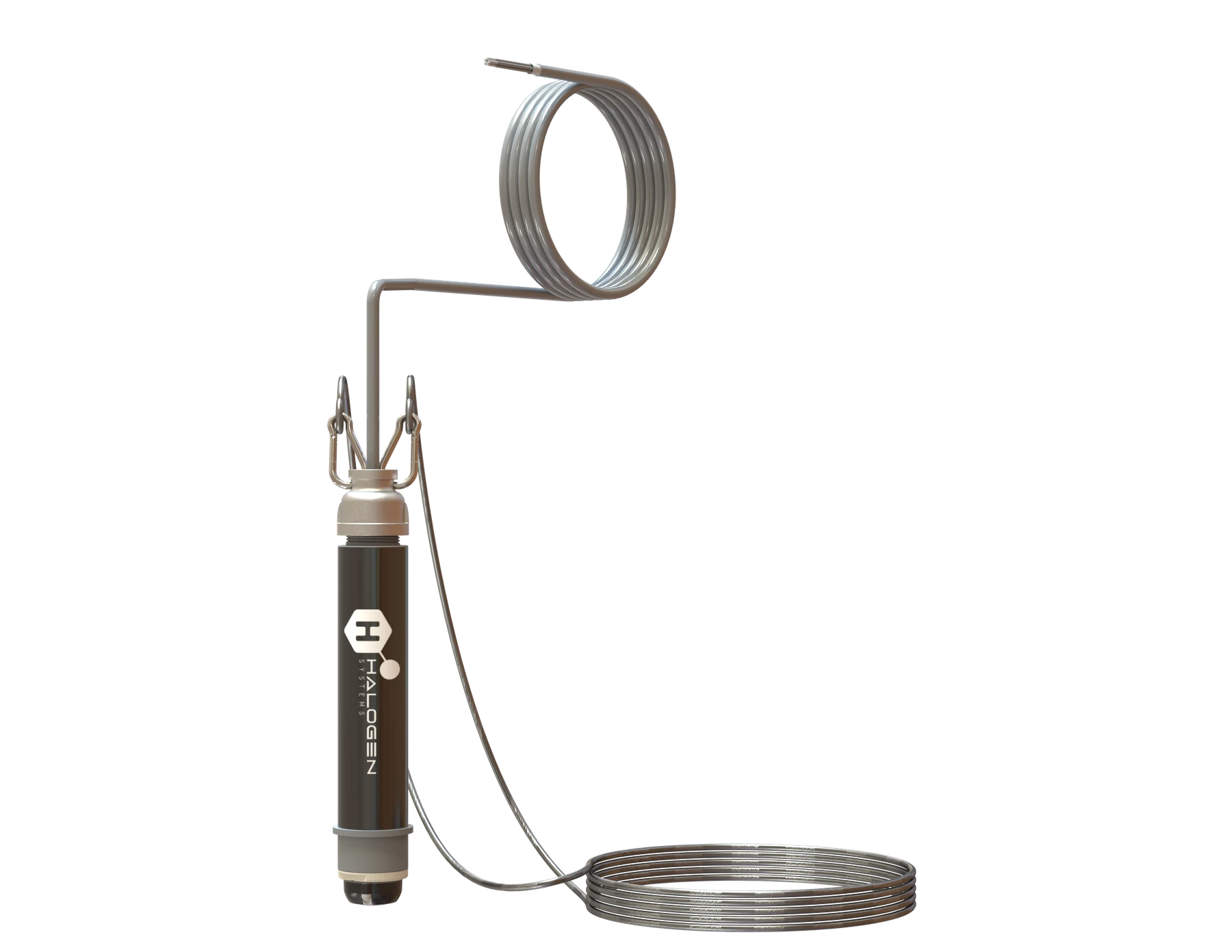
MP-Total shown with cable and suspension hardware. The sensor measures directly in the surrounding water.
Explore MP-Total →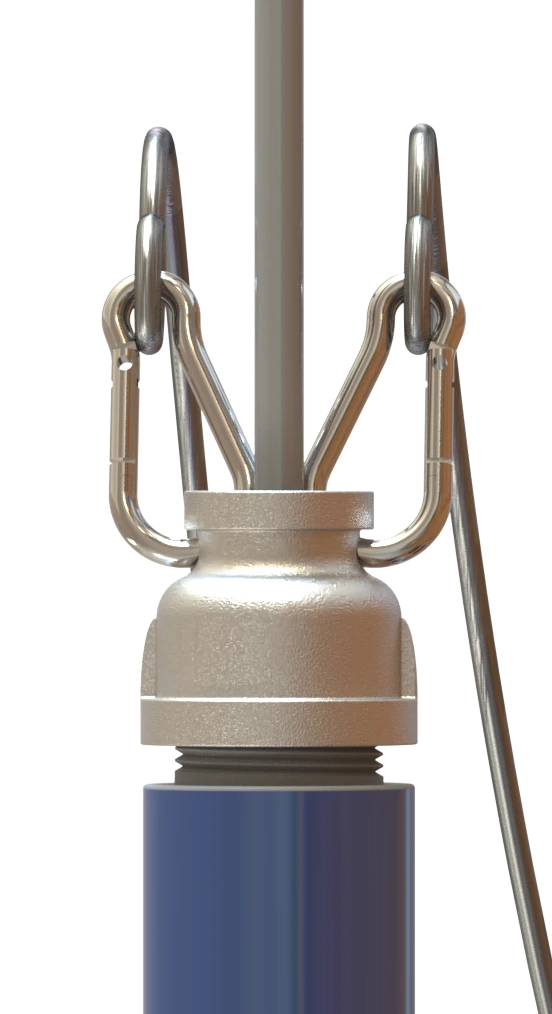
A closer look at the suspension bracket and cable entry on the free chlorine model.
View mounting detail ↗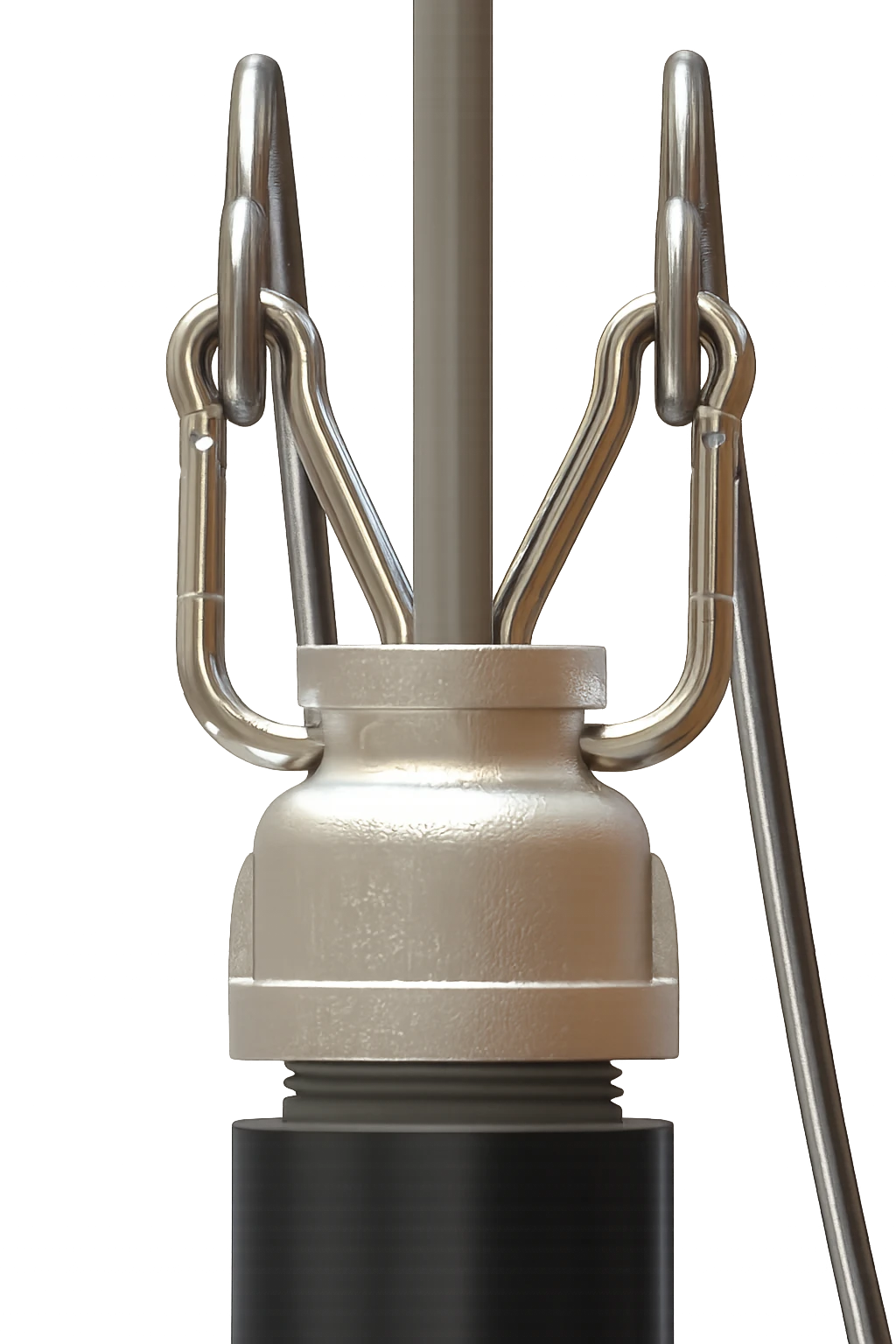
The mounting detail on the total chlorine model, shown at close range.
View mounting detail ↗Product renders show mounting details; final configuration follows the installation guide. Open any image for a larger view.
For rooftop potable-water tanks, building storage and distributed tank networks, the advantage is practical: less equipment to install at each location and fewer sampling components to maintain across the estate.
Install MP5 Free or MP-Total with the sealed immersion assembly and a suitable pole or suspension mount. The impeller supplies local flow, including in still water.
No external sample circuit.Use MP5 Free’s Modbus RTU over RS-485 connection with a compatible third-party telemetry unit or a Halogen controller. Plan the power supply and protected cable route.
Keep your chosen monitoring platform.Your integrator connects readings and diagnostics to your dashboard, trends and alarm workflow. Define who responds when a tank needs attention.
Repeat a consistent installation.Halogen supplies the sensor technology. Telemetry, network connectivity, dashboards and project integration are selected and commissioned as part of your system.
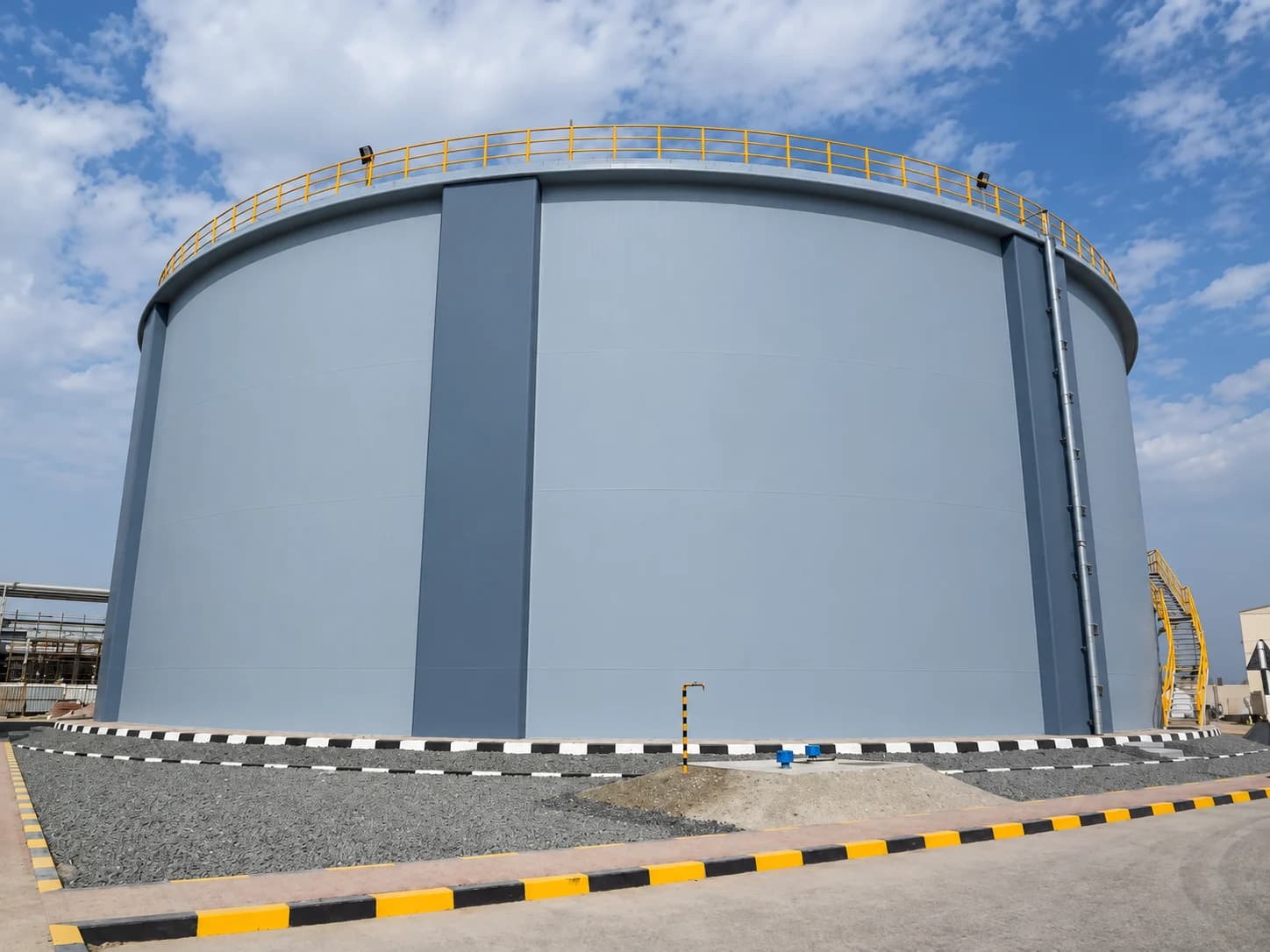
Direct immersion brings chlorine monitoring into the tank, without an external sample pump or return loop.
Representative water-storage setting. Image color adjusted.Measure the chlorine residual and the water conditions around it from the same monitoring point. MP5 Free combines these five measurements in one self-cleaning sensor.
View MP5 Free specificationsAn electrochemical chlorine sensor needs water moving across its sensing surface. Halogen’s integrated impeller provides that local movement while the sensor is immersed. The measurement happens at the monitoring point, even when the tank has little bulk water movement.
Install the sealed assembly at a representative point, below the minimum operating water level.
The spinning impeller moves surrounding water across the sensing surface, right inside the tank.
Connect power and signal wiring to the selected controller or monitoring system for readings and alarms.
The impeller provides local sample flow. It is not a tank mixer; placement still matters when water quality varies with depth or location.
For building owners, operators and system integrators, every extra sampling component becomes another installation and service task. Direct immersion removes the external sample pump, sample tubing and drain or return circuit. Halogen’s reagent-free, membrane-free measurement and SensiCLENE self-cleaning further simplify routine care. Keep the sensor’s calibration and wear-part service plan; remove the work that comes with an external sampling system.
No external sample pump to install or service. No sample tubing, drain connection or engineered sample-return circuit.
Measure the stored water without sending a continuous analyzer sample stream down the drain.
MP5 Free measures chlorine, pH, ORP, conductivity and temperature in one probe, simplifying a multiparameter tank installation.
No reagent replenishment or membrane replacement. SensiCLENE mechanically cleans the electrodes while you retain scheduled calibration and wear-part care.
A pumped sample-loop installation moves water through tubing to an external analyzer. Direct immersion removes that transport step. The water stays in the tank, with no continuous sample discharge and no sample-return plumbing to design.
| Consideration | External sample loop | Halogen direct immersion |
|---|---|---|
| Sample movement | An external pump or available pressure carries water to the analyzer. | The integrated impeller moves water across the immersed sensor. |
| Plumbing | Sample tubing plus a drain or an engineered return connection. | No external sample transport, drain or return loop. |
| Water use | A drain arrangement continuously discharges the sample stream. | The water remains in the tank. |
| Measurement location | At the analyzer, after transport through the sample line. | At the selected monitoring point inside the tank. |
| Service planning | Maintain the sensor and the external sample-delivery system. | Plan access to the sensor, mounting, cable and connected equipment. |
A probe price alone leaves out the sample pump, tubing, installation labor, drain or return work, consumables and repeat service visits. Compare the complete monitoring point over the same operating period. With direct immersion, the external sampling system drops out of that calculation.
Across a building portfolio or municipal tank program, every avoided pump and plumbing connection is one less component to install, inspect and replace.
Request a system-level comparisonUse the same direct-in-tank approach for free or total chlorine. Select the sensor for your disinfectant and water conditions.
IP68 sealed immersion assembly. Confirm installation depth, immersion duration and cable configuration with Halogen. Model-specific measurement specifications still apply.
For monitoring free chlorine residual in chlorinated water. Also listed as MP-5F in the product catalog.
Explore MP5 FreeFor total chlorine and monochloramine monitoring, including chloraminated water applications.
Explore MP-TotalFor rooftop and building-tank projects in Dubai, Abu Dhabi and other markets, drinking-water contact documentation is an important part of sensor selection. Halogen MP sensors are certified to NSF/ANSI 61 for drinking-water contact.
Request the certificate and confirm its scope for the selected sensor, cable and wetted mounting components. Project acceptance remains with the relevant authority; assemble the evidence for the exact configuration being specified.
Review certifications & documentation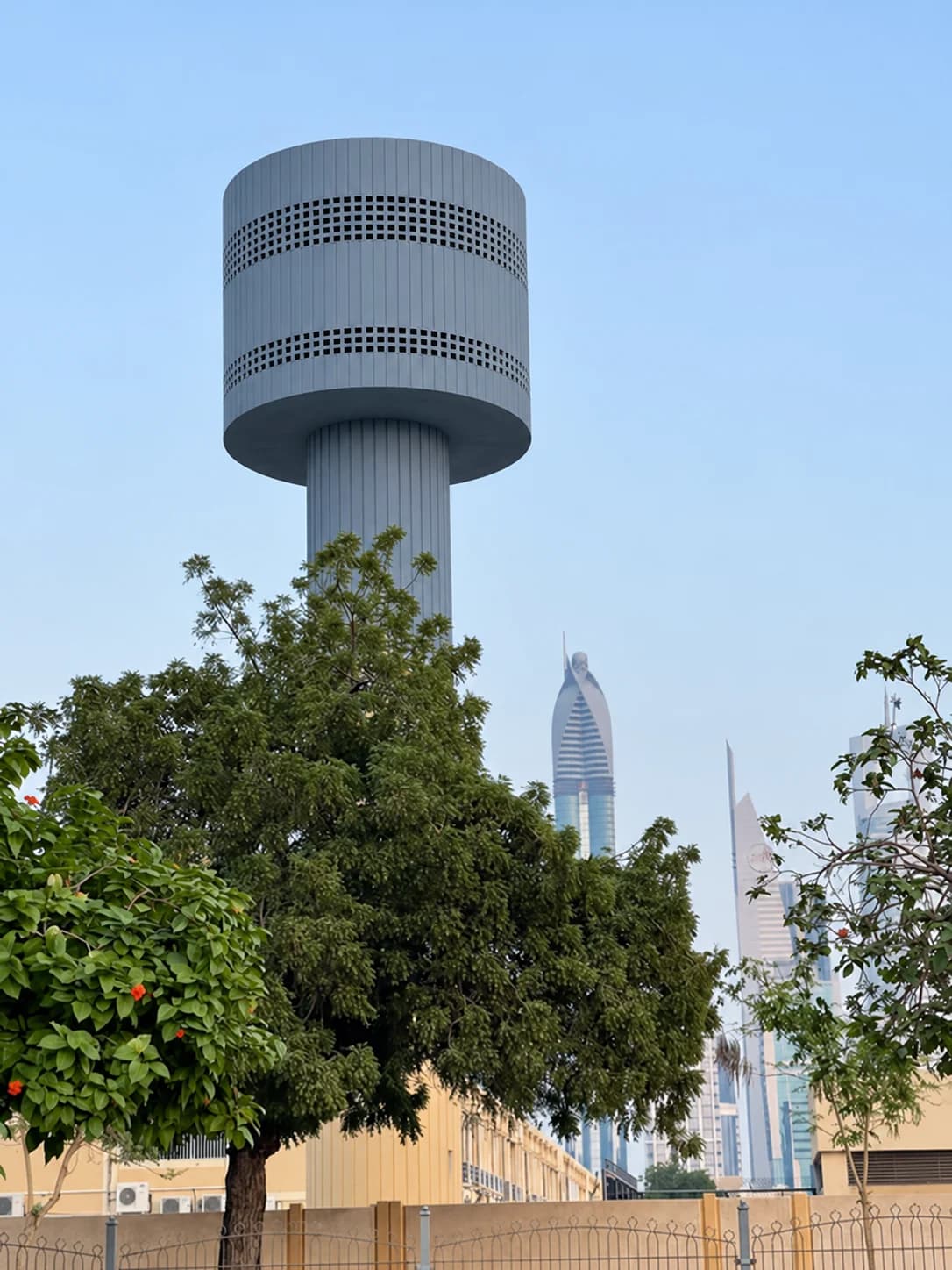
Plan sensor access, mounting and cable routing around the tank. Measure at a representative point that stays submerged as water levels change.
Representative water-storage setting. Image color adjusted.Start with a storage tank, reservoir or clearwell where an immersed sensor can be safely installed and retrieved. Keep the sensing area clear of sediment and obstructions, and submerged as the water level changes.
Choose a point that represents the water you need to monitor. Use tank mixing, turnover and operating practices to decide whether one location is sufficient.
Explore mounting optionsThe Halogen immersion configuration does not need an external pump to deliver a sample to the sensor. Its integrated impeller moves the surrounding water across the sensing surface. The sensor and connected controller still require the appropriate power supply.
The impeller creates local sample velocity at the sensing surface, so measurement does not depend on tank flow providing that velocity. Select a representative location: the impeller does not mix the entire tank or eliminate stratification.
Yes. The immersion configuration is available for MP5 Free and MP-Total. Choose MP5 Free for free chlorine monitoring, or MP-Total for total chlorine and monochloramine monitoring. Use the current model-specific data sheet to confirm the measurements, ranges and water conditions for your application.
The sealed immersion sensor assembly is rated IP68. Confirm the permitted depth, immersion duration, cable termination and mounting configuration with Halogen for your installation. The IP68 rating does not automatically apply to the controller or other above-water equipment.
Direct immersion measures water where it is stored. It does not continuously remove a sample, so there is no analyzer sample stream to drain and no external sample-return line.
It eliminates transport time through an external sample line. The sensor still has its own response time, and the tank’s mixing and turnover affect how quickly a change reaches the monitoring point.
Keep the sensing area submerged at the lowest operating water level, clear of sediment and obstructions, and accessible for inspection, calibration and service. Select an approved support or mounting arrangement. SensiCLENE self-cleaning helps control fouling; it does not eliminate maintenance.
MP5 Free measures free chlorine, pH, ORP, conductivity and temperature in one probe. This consolidates the monitoring point without assembling five separate probes. TDS and salinity calculated by a telemetry system are derived values, not additional directly measured parameters.
Yes. MP5 Free supports Modbus RTU over RS-485 for connection to a compatible third-party telemetry unit or controller. The sensor is not itself a cellular gateway. Review the register map, serial settings, diagnostic registers, power supply and measurement timing with your integrator. A polling interval is not a guarantee of a new stabilized chlorine measurement at that interval.
The published MP5 Free conductivity measurement range is 50–15,000 µS/cm. Water below 300 µS/cm may be within that range; confirm the actual minimum and all chlorine-measurement conditions for the selected configuration. Request a model-specific review for water outside the published limits.
Specify the sensor and complete wetted immersion assembly, NSF/ANSI 61 documentation, mounting, cable routing, power and telemetry connection. Confirm actual water temperature and above-water equipment conditions against the selected model’s limits. Include access for calibration and service, and have the relevant authority review project acceptance.
On-site calibration is supported using the model-specific procedure and a suitable reference measurement. Agree the verification schedule, reference method and spare-parts plan during commissioning. A routine exchange of pre-calibrated heads does not need to be the default service model.
Bring your tank layout, parameter list and telemetry requirements. We’ll help you select the immersion sensor, define the installation and compare the complete system cost.
Design your tank monitoring system