
ENGINEERED FOR WATER. BUILT FOR THE FIELD.
My Halogen Track an order Cloud login
Halogen Systems
CHLORINE MONITORING / APPLICATION GUIDE

Chlorine breakthrough monitoring for fish hatcheries

Evaluate hatchery intake and post-treatment monitoring against the required low-level threshold, response time, reference method and alarm behavior.

Review your monitoring point
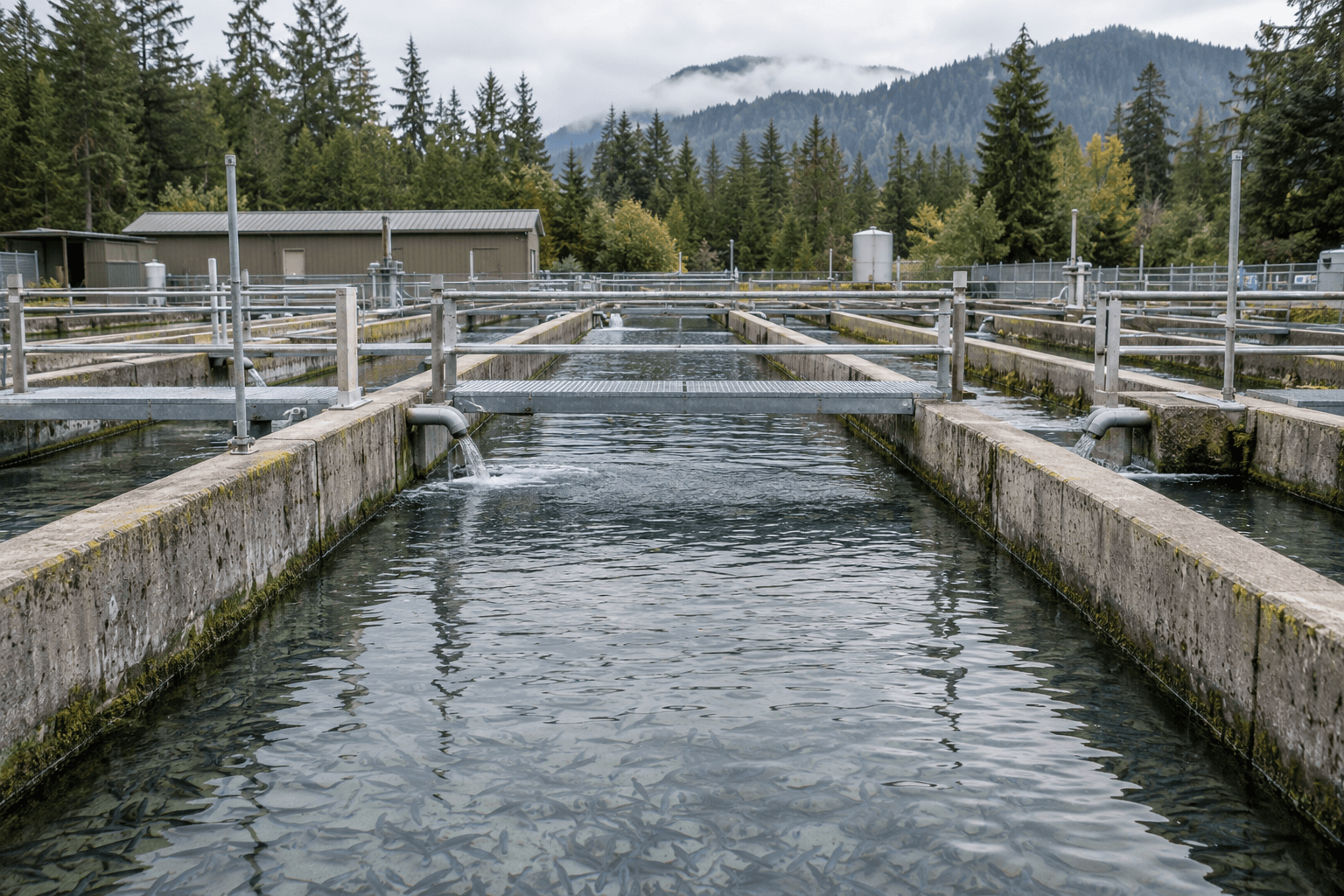
Representative freshwater hatchery with fish in flowing concrete raceways
Representative fish hatcheries & aquaculture setting.
THE SHORT ANSWER

How should a hatchery evaluate a chlorine breakthrough monitor?

Start with the concentration that requires action for your operation, then require evidence that the measurement system can resolve it in the actual water. A general-purpose chlorine range is not enough. Include accuracy near the threshold, total detection delay, salinity, reference verification and the response to equipment failure.

Choose the point that answers your operating question.

  1. EVALUATION POINT 1Source / treated water

    Understand the incoming conditions.

  2. EVALUATION POINT 2Verified measurement point

    Evaluate the treatment or process change.

  3. EVALUATION POINT 3Engineered response

    Define verification and operator response.

Conceptual monitoring sequence. Final placement, detection limits and control actions must be reviewed for your water and equipment.

01 / APPLICATION PLANNING

Define the decision before choosing a sensor

Have the hatchery’s qualified team define the residual species, action threshold and operating response for the species and life stages involved. Share those requirements with Halogen before selecting equipment. This is a feasibility evaluation; no product is recommended here as a validated fish-protection device.

02 / APPLICATION PLANNING

Account for the entire delay

The time between a change in source water and an operator response includes sample transport, instrument response, communications, alarm processing and any valve action. Document each part of that path. A sensor specification alone cannot establish that the full installation acts early enough.

03 / APPLICATION PLANNING

Test low-level performance and failure modes

Arrange a controlled commissioning plan outside occupied rearing systems. Compare against a suitable reference method near the actual decision threshold, not only at a convenient higher concentration. Test loss of power, invalid readings and failed communications with the responsible controls team.

QUESTIONS FROM THE FIELD

Clear answers before you choose.

Can a chlorine sensor prove that water is safe for fish?

No single reading provides that assurance. Instrument capability must be validated against the hatchery’s specific requirements within a broader water-quality and operating program.

Can we monitor after dechlorination?

Only after confirming that the method can resolve the required low concentrations in that water matrix. A displayed zero is not proof of an absence of chlorine.

Can the monitor trigger an automatic shutoff?

That requires an engineered and tested controls design. Confirm outputs, fault handling, valve response and independent safeguards before relying on an automated action.

CONTINUE YOUR RESEARCH

Related monitoring decisions.

LET’S TALK ABOUT YOUR WATER

A better measurement
starts with your site.

Tell us what you need to measure. We’ll help you find the right starting point.

Get a sensor recommendation
Help me choose a sensor ↗