
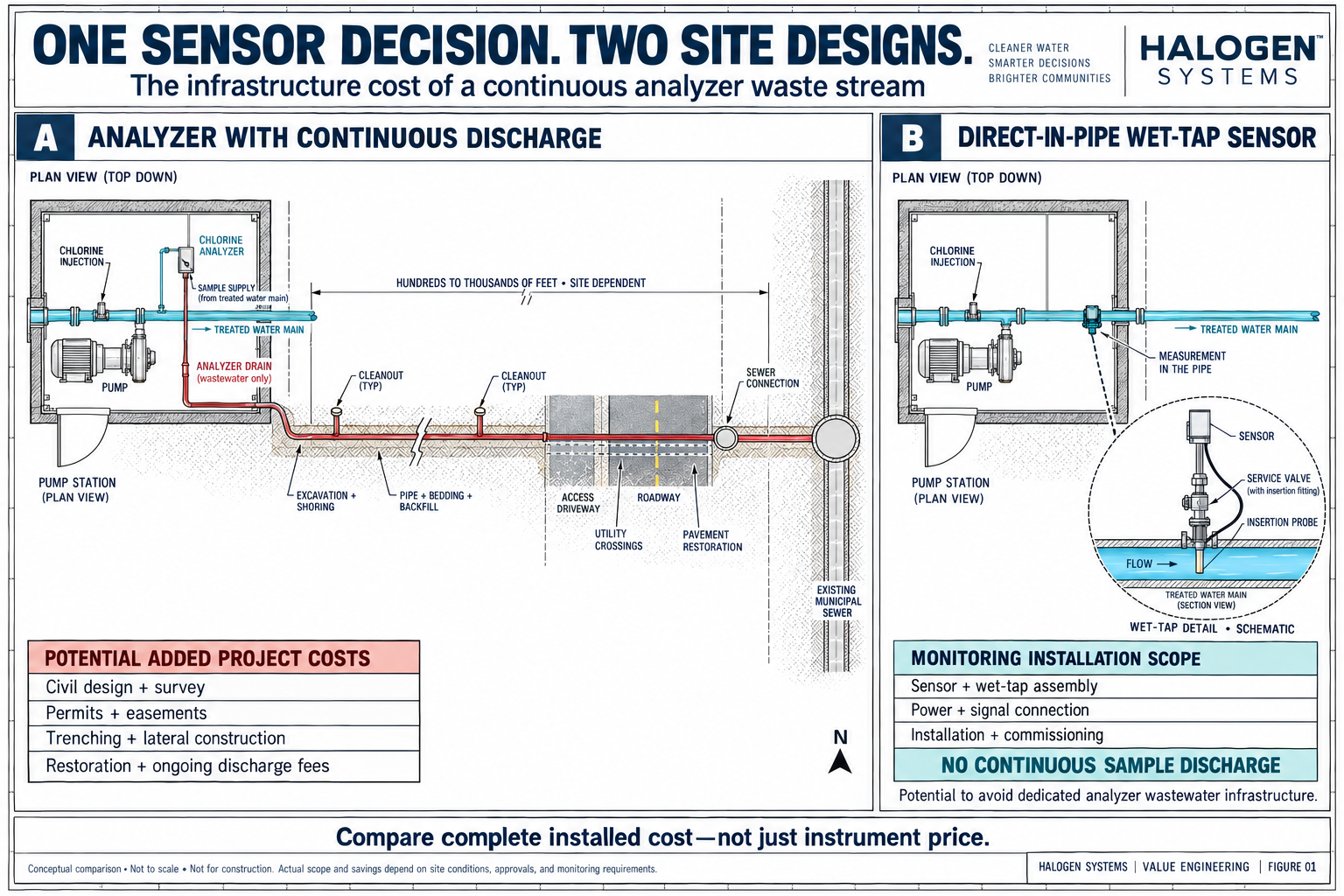
1. Follow the design chain reaction
Begin with a simple question: is the chlorine analyzer the only reason this site needs wastewater infrastructure? A well site may need a pump, chlorination equipment, and monitoring without otherwise needing a sewer connection. An analyzer that continuously discharges sample water adds another system to design.
Trace the sample from its source to its final destination. Account for every flow that leaves the process, including bypass and sample-conditioning flows. Whether the discharge contains reagents, sample water, or both, its quantity and composition affect the disposal design.
| Design decision | Potential downstream scope |
|---|---|
| Analyzer selection | Sample flow, reagent use, pressure control, and drain configuration. |
| Source and treatment | Additional pumped, treated, or purchased water. |
| Conveyance and disposal | Drain piping, freeze protection, storage, hauling, or a sewer connection where required. |
| Review and operation | Design review, approvals, inspections, and recurring water, sewer, labor, and maintenance costs. |
These are possible dependencies, not requirements for every installation. Confirm the actual discharge route and site conditions before assigning costs.
2. Quantify the water before sizing around it
Use manufacturer-specified or measured total discharge and actual operating hours. For one continuously operating discharge stream, annual US gallons = flow in mL/min × 60 × operating hours per year ÷ 3,785.41. Sum all streams and analyzers to establish the site total.
The examples below assume 8,760 hours per year and an illustrative water value of $10 per 1,000 US gallons. They exclude sewer charges, chemicals, labor, and capital cost.
| Example flow | Annual US gallons | Annual water value |
|---|---|---|
| 120 mL/min | 16,662 | $167 |
| 200 mL/min | 27,770 | $278 |
| 500 mL/min | 69,424 | $694 |
Hach's 2025 Chlorine Analyzer Customer Guide recommends 120–200 mL/min through the CL17sc for best performance [1]. The 500 mL/min row is an illustrative design scenario, not a universal analyzer rate. Include any additional bypass flows in the project calculation.
3. Compare complete installed systems
The value-engineering comparison should include the instrument and everything needed to operate it at the proposed site. A small annual water expense can coexist with substantial civil work if a dedicated disposal connection is required.
If an adequate drain already exists, avoided capital cost may be limited. If the analyzer is the only wastewater source, examine whether removing its continuous discharge removes an entire scope item. Do not count shared infrastructure as fully avoided or assume that reducing flow changes equipment sizing.
- Instrument, controller, mounting hardware, installation, and commissioning.
- Sample piping, conditioning, pressure regulation, heating, and freeze protection.
- Drain routing, excavation, restoration, storage, and disposal connection or hauling arrangements.
- Engineering, permitting, inspection, and site access costs attributable to that scope.
- Recurring water, sewer, reagents, energy, labor, maintenance, and waste handling.
Compare the same service life and measurement requirements. Record quantities, local rates, maintenance assumptions, and dated estimates. A project-specific estimate is needed to claim capital savings; this paper does not establish a guaranteed savings amount.
4. Select the installation around the site
Halogen offers wet-tap, direct-inline, immersion, and side-stream mounting options [2]. Direct measurement avoids continuous sample disposal; a side-stream arrangement requires an engineered return path to do so.
| Mount | Application | Design checks |
|---|---|---|
| Wet-tap | Live pressurized main; measurement in the pipe. | Pipe size, pressure, insertion depth, valve geometry, and service clearance. |
| Direct inline / PVC tee | New piping or a line that can be isolated. | Material compatibility, pressure rating, and isolation plan. |
| Immersion | Tank, clearwell, basin, or open channel. | Representative measurement location, access, submergence, and cable routing. |
| Flow cell / side stream | Wall mounting or existing sample plumbing; water may return to process. | Return point, available pressure, backpressure, cross-connection controls, and any residual discharge. |
No continuous sample discharge does not mean no water use during servicing. Confirm application suitability, measurement performance, potable-water contact certification, and the final piping arrangement with the manufacturer.
5. Make the water and waste burden visible in the specification
Ask each bidder to disclose the complete installation scope so proposals can be compared on equivalent terms. Confirm the acceptable discharge or return destination with the responsible project reviewers; requirements depend on the site, water chemistry, and jurisdiction.
- Continuous sample flow and all bypass flows, analyzer count, operating hours, and calculated annual discharge.
- Whether reagents contact the discharge, reagent consumption, and current safety data sheets.
- Required drain or return connection, discharge composition, and proposed destination.
- Sample conditioning, filtration, regulation, heating, and freeze-protection equipment.
- Mounting configuration, service access, measurement requirements, and applicable potable-water contact certification.
- Five-, ten-, and twenty-year operating assumptions, with capital costs shown separately.
A disposal option should not be assumed acceptable solely because it is physically available. Obtain the project-specific approval for the proposed route.
6. Document the value-engineering decision
Build a short project record showing the baseline design, the alternative, and the scope that changes. Attach the original analyzer schedule, flow calculations, piping drawings, reviewer correspondence, and an itemized estimate or bid comparison.
Calculate water reduction as baseline discharge minus revised discharge. Calculate avoided capital cost from scope actually removed, subtracting the added cost of the alternative installation. Keep recurring savings separate and state the evaluation period. Confirm the final design and commissioning outcome before presenting the result as a completed case study.
The engineering opportunity is to consider the waste stream early enough to influence the design. Before sizing a disposal system around an analyzer, evaluate whether a suitable monitoring configuration can eliminate the continuous discharge.