Chlorine Analyzers & Water Conservation
A California city colved its water waste and infrastructure challenges with a new in-pipe chlorine sensor
THE WATER SUPPLY for the City of Lakewood (Calif.) is 100% groundwater. The city draws all of its water from the Central
Basin aquifers and pumps approximately 6,500 acre-feet of groundwater per year, operating 11 deep wells with approximately 180 miles of water mains that range from 4-27 inches in diameter. The city also has three water storage facilities, which hold approximately 13 million gallons, and two treatment facilities.
In 2018, the city started looking for a chlorine sensor that wouldn’t require a waste stream, as some of its wells don’t have the infrastructure to effectively drain the waste stream generated from its existing chlorine analyzer. The city verified chlorine residuals by collecting daily grab samples at several well locations. However, this process wouldn’t notify operators if, for whatever reason, chlorine wasn’t injected into the distribution system. This issue could result from air-locking, chlorine feed pump failure, or a break or leak from the chlorine feed line.
In addition, water consumption was a factor for the city. The city’s amperometric sensors and N, N-diethyl-p-phenylenediamine (DPD) instruments required a waste stream of up to 69,000 gallons of water. This amounts to 0.2 acre-feet of water per year. At the city’s billable rates, this is $690 per year in non-revenue water. A primary concern in California is water consumption. After almost a decade of drought, California water agencies are looking for ways to conserve water.
The Search Begins
The city started searching for a wet tap chlorine analyzer that was approved by the National Science Foundation (NSF) and American National Standards Institute (ANSI) and didn’t generate a waste side stream. After several months, the city found a company, Halogen Systems, which advertised a chlorine analyzer for seawater use. Although the analyzer wasn’t NSF/ANSI 61-approved, the city worked with the company on trial projects to determine whether the analyzer would meet its needs.
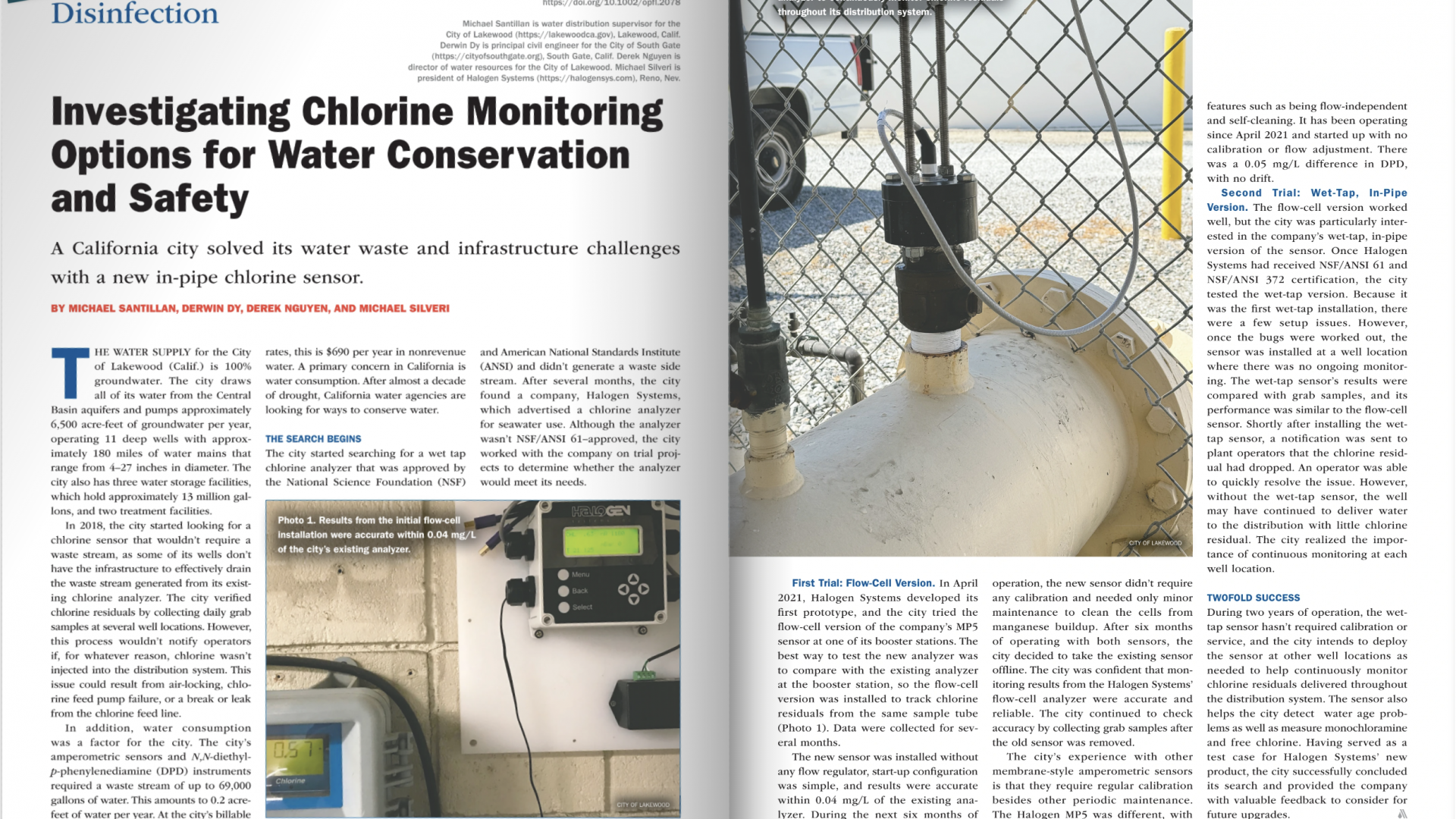
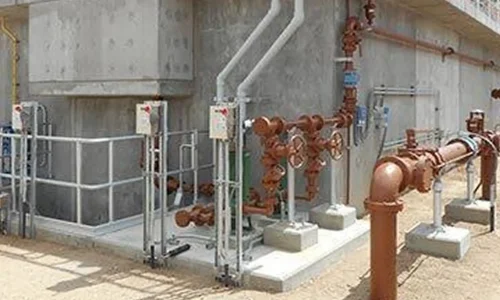
First Trial: Flow-Cell Version. In April 2021, Halogen Systems developed its first prototype, and the city tried the flow-cell version of the company’s MPS sensor at one of its booster stations. The best way to test the new analyzer was to compare with the existing analyzer at the booster station, so the flow-cell version was installed to track chlorine residuals from the same sample tube (Photo 1). Data were collected for several months.
The new sensor was installed without any flow regulator, start-up configuration was simple, and results were accurate within 0.04 mg/L of the existing ana-lyzer. During the next six months of operation, the new sensor didn’t require any calibration and needed only minor maintenance to clean the cells from manganese buildup. After six months of operating with both sensors, the city decided to take the existing sensor offline. The city was confident that monitoring results from the Halogen Systems’ flow-cell analyzer were accurate and reliable. The city continued to check accuracy by collecting grab samples after the old sensor was removed. The city’s experience with other membrane-style amperometric sensors is that they require regular calibration besides other periodic maintenance.
The Halogen MP5 was different, with features such as being flow-independent and self-cleaning. It has been operating since April 2021 and started up with no calibration or flow adjustment. There was a 0.05 mg/L difference in DPD, with no drift.
Second Trial: Wet-Tap, In-Pipe Version. The flow-cell version worked well, but the city was particularly interested in the company’s wet-tap, in-pipe version of the sensor. Once Halogen Systems had received NSF/ANSI 61 and NSF/ANSI 372 certification, the city tested the wet-tap version. Because it was the first wet-tap installation, there were a few setup issues. However, once the bugs were worked out, the sensor was installed at a well location where there was no ongoing monitoring. The wet-tap sensor’s results were compared with grab samples, and its performance was similar to the flow-cell sensor. Shortly after installing the wet-tap sensor, a notification was sent to plant operators that the chlorine residual had dropped. An operator was able to quickly resolve the issue. However, without the wet-tap sensor, the well may have continued to deliver water to the distribution with little chlorine residual. The city realized the importance of continuous monitoring at each well location.
Twofold Success
During two years of operation, the wet-tap sensor hasn’t required calibration or service, and the city intends to deploy the sensor at other well locations as needed to help continuously monitor chlorine residuals delivered throughout the distribution system. The sensor also helps the city detect water age problems as well as measure monochloramine and free chlorine. Having served as a test case for Halogen Systems’ new product, the city successfully concluded its search and provided the company with valuable feedback to consider for future upgrades.
De nombreuses applications bénéficient d'un analyseur autonettoyant nécessitant peu d'entretien
La technologie d'Halogen contribue à maintenir des étalonnages stables tout en réduisant les besoins de maintenance. Cette combinaison fait du MP5™ une option intéressante pour les stations de surveillance qui pourraient autrement nécessiter des déploiements constants d'équipes pour des interventions de l'opérateur. Lorsqu'il est associé à des options de télémétrie à distance, le MP5™ peut constituer la base de solutions de surveillance IoT. Voir ci-dessous des exemples d'applications.

RÉSERVOIR À DISTANCE
Suspendu directement dans un réservoir d'eau potable, un capteur de chlore MP5™ peut transmettre des données via une option de télémétrie cellulaire. Lorsqu'il fonctionne avec un kit de batterie en option, le MP5™ peut échantillonner à des intervalles prédéfinis et fonctionne sans intervention de maintenance pendant un mois.

TESTS DE FIN DE LIGNE
Les municipalités qui doivent actuellement déplacer un camion pour savoir avec certitude que les foyers en bout de ligne reçoivent une concentration en PPM appropriée peuvent réduire les coûts et augmenter la précision en plaçant un MP5™ directement dans la conduite d'eau du quartier. Les données peuvent être diffusées via la télémétrie cellulaire.

SURVEILLANCE DU RÉSEAU
Le vieillissement de l'eau et d'autres problèmes de dégradation dans un réseau de distribution peuvent être décelés en déployant des analyseurs MP5™ aux points souhaités du système. Les opérateurs peuvent suivre la température, la conductivité, le pH et même l'ORP, quels que soient le débit ou la pression (jusqu'à 10,5 bars) via les options de télémétrie à distance.

EAU POTABLE DES BATEAUX DE CROISIÈRE
Pour se prémunir contre la légionellose, les compagnies de croisière doivent surveiller les niveaux de chlore dans leurs réservoirs d'eau douce, se protéger contre la contamination provenant des fournisseurs et effectuer des prélèvements aux robinets. La technologie SensiCLĒNE™ et les options d'installation flexibles de l'analyseur MP5™ permettent aux opérateurs de créer des solutions adaptées à cet environnement difficile.

SURVEILLANCE DES CAMIONS-CITERNES D'EAU DANS LES COMPAGNIES AÉRIENNES
Des études menées au Royaume-Uni montrent que les camions-citernes d'eau sont une source de contamination de l'eau potable dans les compagnies aériennes, mais la surveillance de ces unités mobiles de remplissage est un processus très manuel, ce qui rend la cohérence difficile dans un environnement où tout doit aller vite. Autonettoyant, durable et indépendant du débit, le MP5™ peut être la base d'une solution côté source.
SURVEILLANCE DE LA RÉUTILISATION DE L'EAU ENVIRONNEMENTALE (REE)
La réutilisation de l'eau environnementale (REE) est un sujet d'actualité dans les régions confrontées à des pénuries d'eau, mais les réservoirs de stockage éloignés peuvent également devenir des points chauds pour toutes sortes de proliférations bactériennes. Grâce en partie à SensiCLĒNE™, le MP5™ n'est pas affecté par le débit et la turbidité, ce qui en fait un bon choix pour construire un système de surveillance robuste et nécessitant peu de maintenance.
Latest Blog


Légionellose et surveillance de l'eau des navires de croisière

Discussion franche au sujet des analyseurs de chlore à « surveillance continue »